







Fountainhead on Fretless Guitar, Creative Necessity, and the Making of Changeling
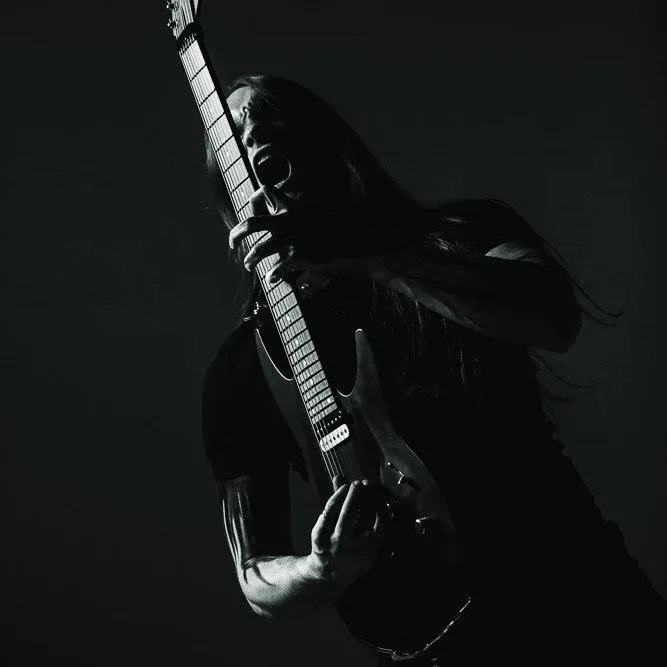
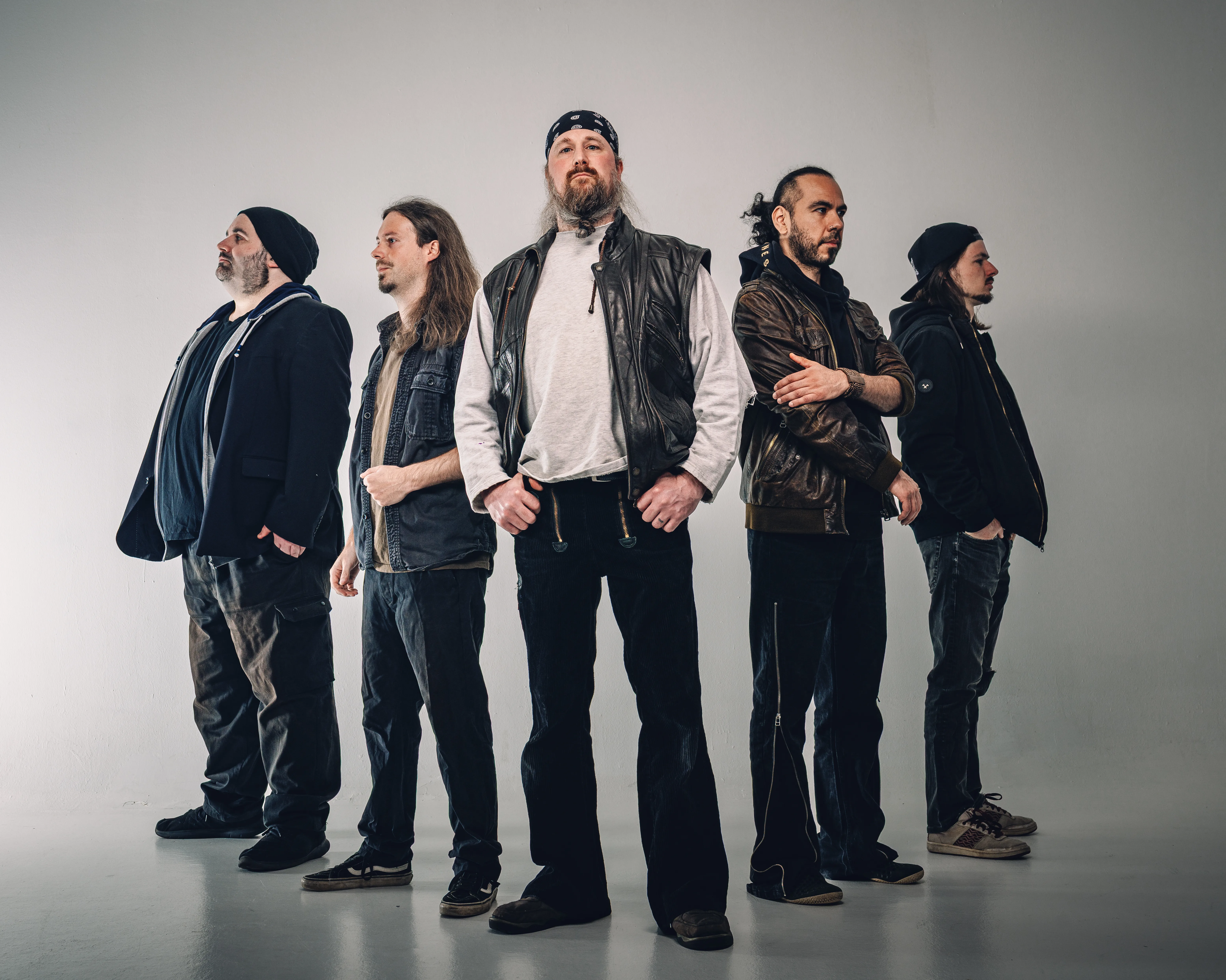
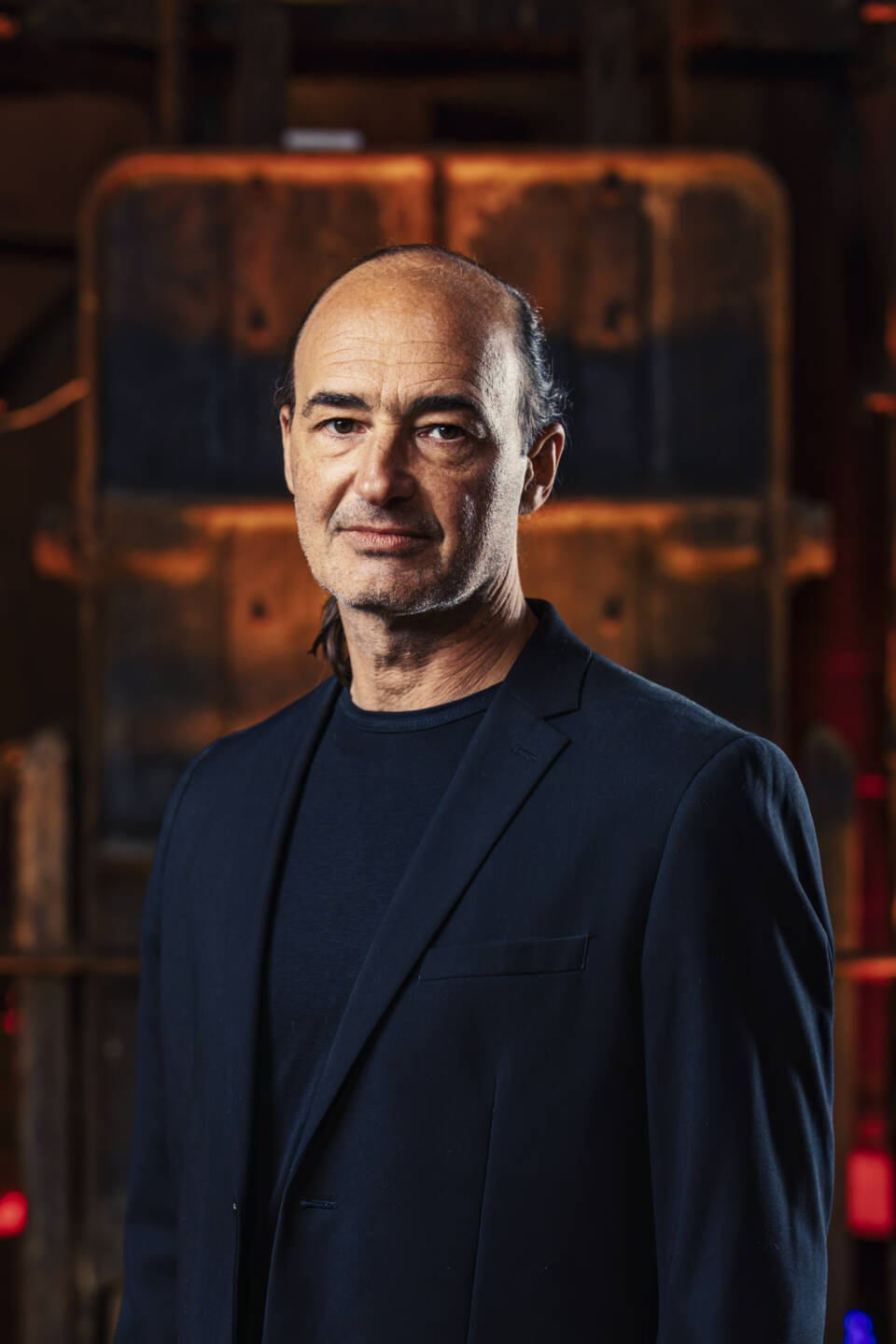
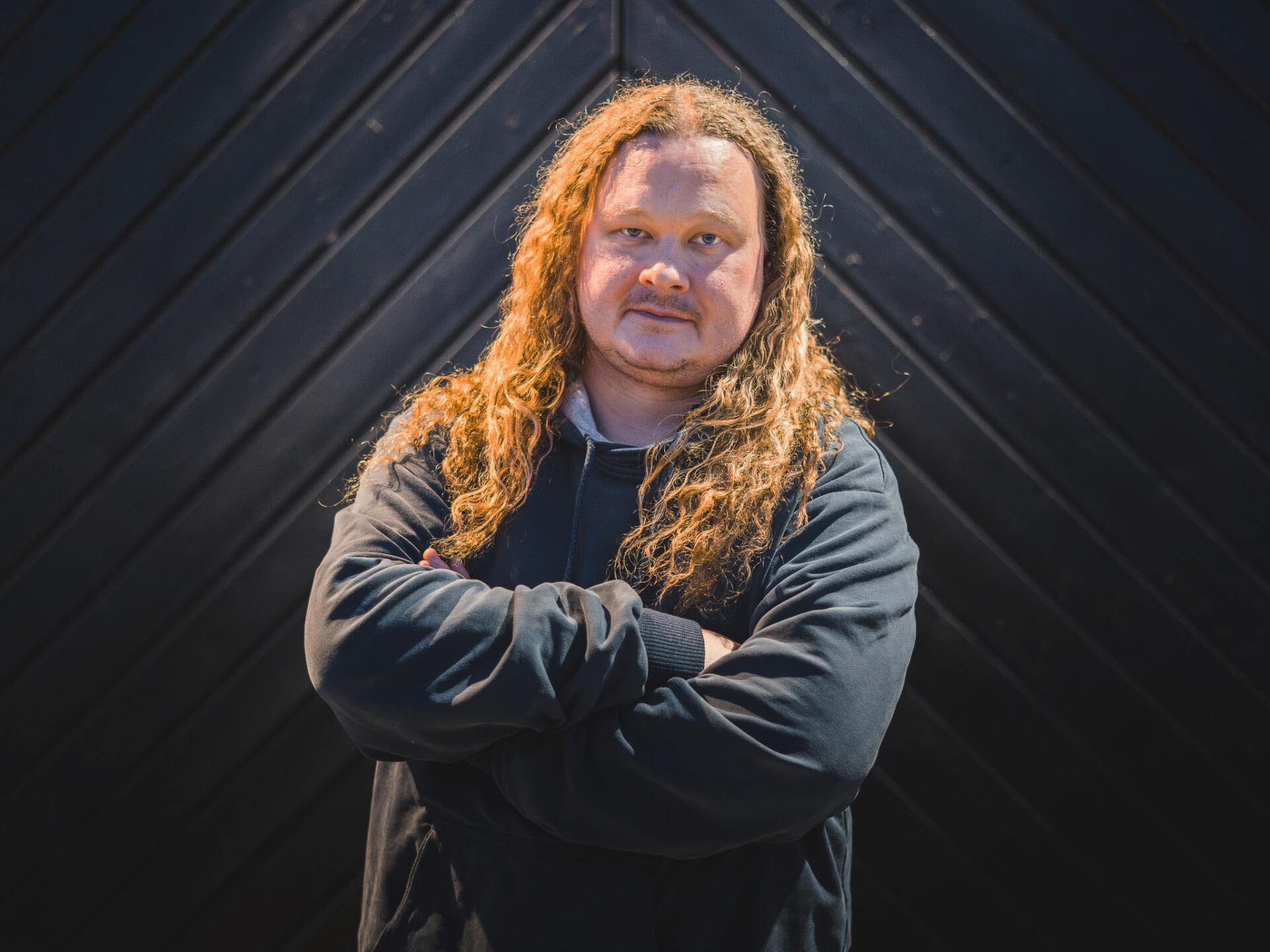
Tom Geldschläger, better known as Fountainhead, is a guitarist celebrated for astonishingly technical lead work – including his distinctive fretless guitar approach – whose résumé spans extreme metal and prog landmarks as ex-Obscura, ex-Belphegor, ex-Defeated Sanity, and ex-Amogh Symphony. With his newly formed band Changeling, he’s just released the self-titled album “Changeling”, which The Progspace’s readers voted Best Debut Album as part of the 2025 Progspace Awards. Beyond his work as a player and composer, Geldschläger is also an in-demand producer and recording engineer, operating from his Berlin studio, where he shapes dense, high-detail productions that match his forward-looking musical vision. The Progspace got to chat with Fountainhead about the unlikely road that led to “Changeling”, the musical principles that drive him, and the technical and conceptual choices behind the album’s sound and structure.
Welcome, Tom. Thanks for taking the time to speak with The Progspace.Fountainhead: Thanks to you for the opportunity.
To start, what’s your background? How did you get into music?Music was always a big factor at home. My father, before I was born, was basically on track to become a professional musician in the DDR. He quit – hung up the guitar and microphone – when I was on the way, to support the family. But music stayed central while I grew up.
Later, when I was becoming a teenager, my father also had a record shop. If you grow up around a record shop, that fascination is intense. With my parents’ support I started on classical guitar pretty early, played that for a few years – and then the hormone wave hit, and suddenly it was metal. You see people like Joe Satriani on these album covers, with long hair, flying over some melted space clock with a chrome guitar, and I just knew: that’s what I want to do with my life.
It wasn’t an intellectual decision. It didn’t feel like a slow development. It was suddenly clear. A calling, basically.
So Satriani and the classic “guitar hero” thing – where guitar is the main voice, not just accompaniment.Exactly. That was the ignition point. But I was never only in that world. At the same time I absorbed all kinds of other music, not just guitar-centered stuff. Still, it made me feel: I can see myself in that role.
Of course, I had no real way to do that where I grew up – small village in Mecklenburg-Western Pomerania. But it became a path in my head, and somehow it did unfold.
How did you go from that spark to becoming the player you are?The direction was clear – even if the “how” was complicated. After school I wanted to study jazz guitar, but I wasn’t good enough. I didn’t have the jazz skills.
I tried auditions, tried to get into an existing scene. I even auditioned for Necrophagist in 2004. I wrote my own music too, but mostly I got laughed at, bullied – no encouragement, no positive words. It was chaos.
Then in my mid-20s I moved to Berlin with a guitar and a suitcase in a big personal crisis, no degree, no completed studies. I thought: maybe here I can still find a way in as a musician, because I didn’t have other options.
That didn’t work either. Instead I had two kids, and at least I stopped drinking. Then I had heart surgery in my mid-20s. When I came out of the operating room, it felt like: you’ve been given a second chance. And what I immediately thought was: the music I wrote – music I never released because I was told it wasn’t good enough, or it was too weird, or nobody would want it, and I internalized all of that – this is the moment. I have one life. I need to do what I’m here to do: release my own music.
So I took songs I’d written at 17 or 18 in my childhood bedroom, songs that got rejected, and I recorded and released them. That became my first solo album, “Fear is the Enemy”. And that slowly led to things. It reached people who then told other people. Suddenly I had opportunities to play and record with international musicians like Jimmy Pitts and Marco Minnemann – I did two albums with them. That all came from finally having the courage after the surgery to say: I’m doing this, regardless of what happens.
And that also led to joining Obscura, and from that point on it became clear that I was part of the scene – and not as rejected as I’d felt for years.
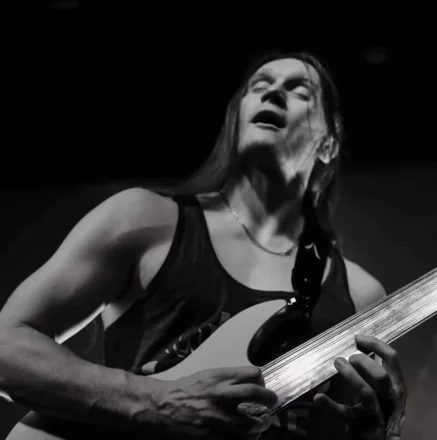
Honestly, I think I have more influences from outside metal than inside. I grew up as a metal kid and I’m at home in it, but my influences were rarely “pure metal.” As a kid I worshipped Mike Oldfield. Later: Aphex Twin, Squarepusher, Björk, Ravi Shankar.
For me there isn’t really “good” and “bad” music – maybe something like bro-country, I don’t know – but generally it’s not about value judgments. There’s music that moves me and music that doesn’t. Last year I listened to a lot of K-pop because my daughter infected me with it, and I hear more interesting ideas there than in a lot of western pop, even if parts of the industry are problematic.
I’ve heard explanations that a lot of taste comes down to how our brains interpret what we hear – our internal “tuning,” so to speak.That’s a great point. Taste is tied to subjective perception. We all have songs linked to formative experiences. If you discovered that same song one day later – without the event – it might not mean anything to you. It’s complex.
I also needed a long time to accept that my brain works differently. As a teenager you want to be normal, to belong. But I had to accept that certain things just happen in me – for example, I can hear music in my head that doesn’t exist yet. Or I can hear a piece and immediately reassemble its components mentally, link it with other things. For years I thought everyone could do that. Then I learned: no, not everyone can.
Once I accepted that it’s “unusual” but not bad, I understood why some music interests me less. I can appreciate a Judas Priest song and respect it, but the number of permutations my brain can do with it is small. So it’s less engaging to me creatively.
Because it’s nailed down; fewer alternative paths.Right. And certain music must be nailed down, otherwise it loses its power. If Judas Priest asked me to write an album for them, that might be impossible for me – because my nature is to take things apart and rebuild them. Nobody wants Judas Priest dismantled and rebuilt.
That’s probably part of what draws people to progressive music: comfort with not immediately recognizing or understanding something, but still wanting to explore it.Exactly. It’s out of fashion in a world of playlists and singles, but it’s how I think and feel music.
A more technical topic: your fretless guitar. How did that happen, and what do you get from it?It’s a lot of freedom – and a lot of responsibility. The short version: as a teen I was a big Steve Vai fan and played a Vai-style guitar with a whammy system I abused constantly. At one gig the system basically exploded onstage, and parts hit my face. The guitar was ruined.
I couldn’t just go buy another guitar. So I went to the only guy in town who repaired guitars and asked: can we do anything with this? I considered building in a fixed bridge, maybe a MIDI pickup – but too expensive.
Around that time I’d just started using the internet and discovered underground guitarists via forums – like the John Petrucci (Dream Theater) message board. We exchanged transcriptions and burned CDs for each other. That’s how I discovered Ron “Bumblefoot” Thal, who was experimenting with fretless guitar back then.
So I thought: maybe I’ll just do that. The repair guy pulled the frets, filled the slots with what he had – wood from a bowling alley – poured lacquer over it, and I had a fretless guitar.
Then I went to jazz-guitar school auditions wearing a Cannibal Corpse shirt, played a homemade fretless, and performed a drum’n’bass version of jazz standards. They looked at me like I was from Mars.
Not the right context.Exactly. I was happy because I could do something nobody else did. That’s still important to me. I can’t release an album under my name – an album where I’m leading – unless I’m sure it offers something that only exists there, in that form. That’s a condition for me.
I didn’t understand at the time that you also need the right context. Jazz professors are there to check whether you can do the basics, so they can invest in you for years. I learned that later. But I stayed with fretless because it let me do things that wouldn’t otherwise be possible.
That “must be novel” requirement – where does it come from?If it isn’t, I’ve failed my assignment. It’s about contributing. The musicians who shaped my understanding – whether as guitarists or as artists – were always people you could identify immediately. They built a language, or a context, that was their own.
For me it was obvious: that’s how you do it. Someone like Frank Zappa is a model of a meaningful life – adding something to music that wasn’t there before, expanding it. I’m not dividing people into “good” or “bad,” but for me, serving music means trying to extend it.
For Changeling, most rhythm parts are single takes per section. Not “the whole song in one take,” but each part is a take. Sometimes I do comping, but not usually because one take is “bad” and another is “good.” More like: when guitars are double- or quad-tracked, I might have five good takes, and then I’ll spend a ridiculous amount of time combining them so the intonation of the chords matches left and right.
It’s about your own standards. For your own music you’re the boss – you do it until it sits. For someone else, if it’s not that important and you need a shortcut so it doesn’t harm you, that can be legitimate too.
A lot of beginners don’t know how to interpret professional recordings. Recording can be ego-destroying.Sure. Most people – especially in metal – aren’t primarily trying to show what they can do, because it’s always less than you think. Same for me. I laugh when people tell me how incredible my playing is, because if they knew how much I struggle every day to maintain or reach the level you hear at the end…
The difference is: I’m relatively transparent about that. Many aren’t. Often it’s a flex.
Changeling feels like fresh air in progressive metal, which can sometimes feel familiar even when it’s virtuosic. How did this album come together?Thanks. The funny part is: Changeling isn’t something I haven’t done before. It’s just in a more concentrated form, at a bigger scale. The last time I did something like this was on the “Akroasis” album for Obscura – though to this day most people don’t know who did what there.
My solo albums are known by fewer people and are smaller in scale – fewer musicians, less budget, shorter running times. Changeling is basically what I’ve always done, but turned to eleven.
When did you write it? What was the composition process?It started in the pandemic. I was sitting with Christian Münzner (solo, Eternity’s End, Ex-Alkaloid, Ex-Obscura, Ex-Necrophagist), an old friend, and we were both extremely fed up with the situation around Obscura. We weren’t allowed to play the contributions we’d made – the songs we’d written. People can piece together the details themselves; it’s online.
We said: let’s do something together. Each of us writes songs, we start a new project, and if we do it right we can tour – and maybe even reclaim the old material by playing it again.
Then it went differently. Christian rejoined Obscura after getting an offer he couldn’t refuse. History took its course. But by then I’d written enough material that turning back felt stupid. I continued alone.
Also, to be honest, I wouldn’t have chosen to write an album in this style by myself, because my time in Obscura – and what happened after – was deeply traumatic. I was in therapy for a long time because of it. And I think it’s fair now, publicly, to use the word abuse.
And you weren’t the only one affected.I was never the only one. It only looked that way publicly. But anyway – continuing the music helped me climb out of that. The album started as a straight push into established tech-death. But if you leave me alone, the direction shifts toward what feels more like me. So the concept evolved.
Listening front to back, the early songs feel closer to that classic tech-death language; the last two feel like the music grows beyond it. Is that also the writing order?Partly. If you ignore the intro, the first two songs – ’Instant Results’ and ‘Falling in Circles’ – were written for that initial plan with Christian. I built the album as four chapters. Streaming listeners may miss that, because it’s indicated in the physical packaging.
Chapter 1 is a reboot, a loving embrace of the style and its influences. I spent time adding small quotes and references – pointing a finger and saying: look, this is where it comes from. Like in jazz, where you demonstrate vocabulary by invoking known phrases.
I’m standing on the shoulders of bands that made this possible: Cynic, Death, Morbid Angel – and also my own past in that style, through Obscura. That’s why ‘Falling in Circles’ is a deliberate self-quote.
You also have very specific guests.Because in Chapter 1 it mattered to me that it wasn’t only me. I wanted musicians whose presence legitimizes the tribute and points back to the roots. For me the holy trinity of technical death metal is Death, Cynic, and Morbid Angel.
So: Jason Gobel, who played on Cynic’s “Focus”; Andy LaRocque, who played on Death’s “Individual Thought Patterns”; and Bill Hudson, a long-time friend, who plays in I Am Morbid, the continuation of the classic Morbid Angel material.
Chapter 1 ends with the first interlude. Chapter 2 begins with the title track ‘Changeling’ and ‘Abyss’ and ends with the second interlude. The idea is: I’ve paid tribute – now what do I do with the style? Can I keep the identity so clear that you can drop the needle anywhere and instantly know it’s technical death metal, but make the “how” new?
Chapters 3 and 4 are the long tracks. If Chapter 1 is the past and Chapter 2 is the present, Chapters 3 and 4 are my personal future. Not “the future of music,” but where I want to take it.
On ‘Abyss’ – what’s the “new ingredient”?‘Abyss’, as far as I know, is the only metal song on the planet that modulates up and down by a quarter tone.
It can sound dissonant if you’re not used to it.It’s not about dissonant intervals. The intervals stay the same; the entire song shifts. For example: the first chorus is in standard A=440Hz, but the third chorus and the whole middle section are a quarter-tone higher. The third chorus is musically the same as the first and second – just a quarter-tone higher.
Making that work without a jarring break is complex. Jacob Collier inspired me there. It’s not about being “weird” for its own sake – it gives you a tool to make sections feel brighter or darker. When the song shifts up, it feels lifted and more radiant; when it returns, it feels heavier, darker, like a drop and a freeze.
There are other references too: the choir at the beginning and end is an adaptation of Ligeti’s “Lux Aeterna” – some will recognize it from (the film) “2001: A Space Odyssey”. There’s a lot in ‘Abyss’ that isn’t common in metal.
Can you play it live?Yes, absolutely!
The last songs feel huge – almost like an entire ensemble.Especially ‘Anathema’, yes. It’s the band plus colors that appear elsewhere on the album. The oud is there – I wrote a lot of the album on oud. There’s a full orchestra and a full choir, mixed voices. For that song there’s also flamenco palmas: multiple types of claps and voices layered. In stereo it’s cool, but in Dolby Atmos it makes much more sense, because you can be inside that group and hear the layers around you. There’s also a church organ.
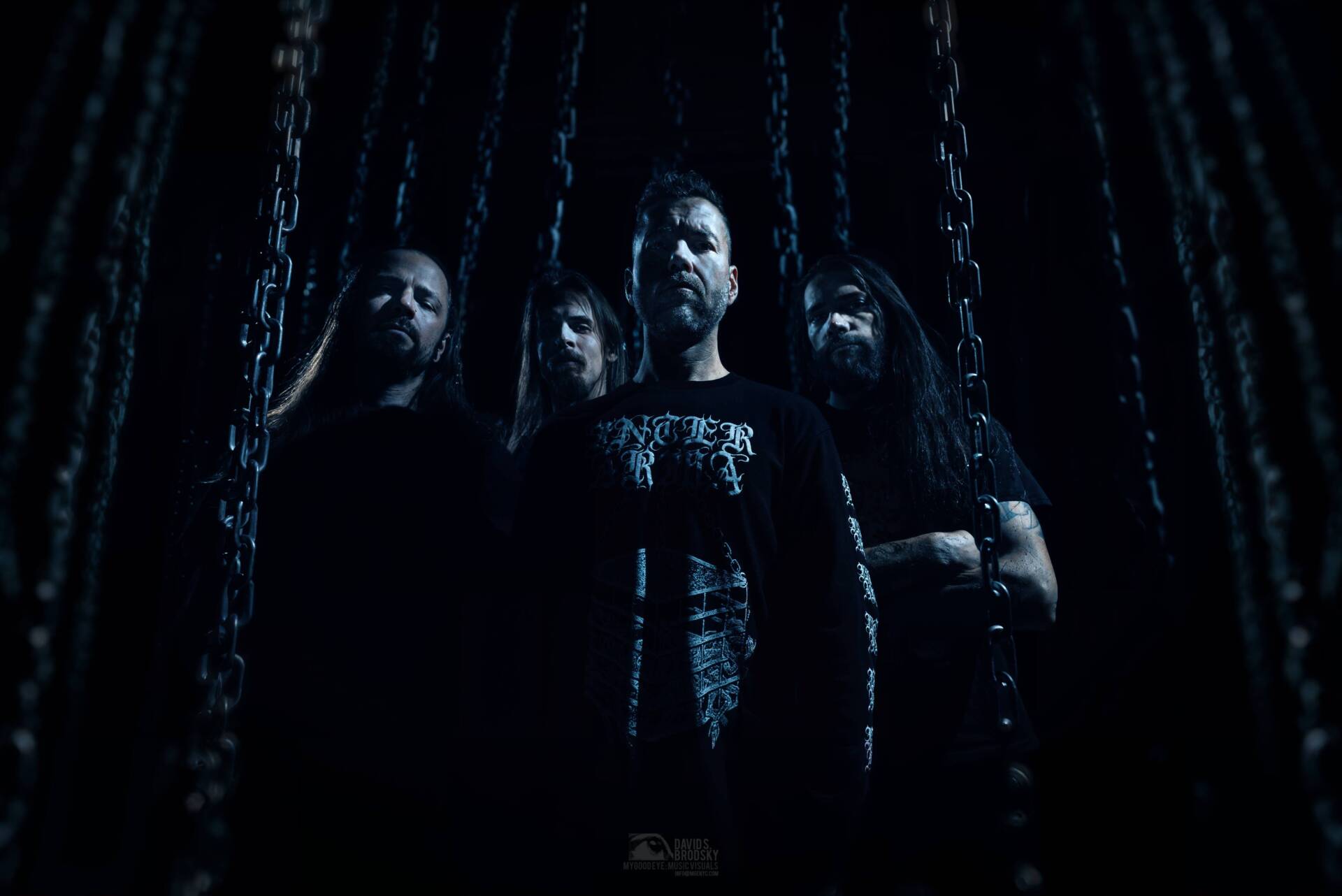
And ‘Abdication’ – there are sounds that could be mistaken for synths.There are basically no synth sounds there. Synth is mostly limited to ‘Instant Results’. The concept is: the core across the whole album is the band – me, Arran (Arran McSporran, fretless bass, Vipassi, Virvium, Cosmitorium), Morean (vocals, Alkaloid, Noneuclid, Ex-Dark Fortress), Mike Heller (drums, too many bands to list, Ex-Fear Factory among many), plus backing vocals by Alexander Kerski. Then each song has a different orchestration color.
‘Instant Results’ has microtonal synth colors. Those colors get introduced separately and then combined toward the end – thesis, antithesis, synthesis. ‘Abdication’ is mainly big orchestra: brass, woodwinds, strings, and especially mallet instruments – marimba, piano, vibraphone. Those colors are rare in metal. There’s also some percussion like handpan and tabla across the album.
What should listeners know that they might miss on the first listen?A lot is designed to reveal itself layer by layer. Also, even though everything is recorded to a click for technical reasons, the album isn’t “one tempo per song.” It’s often one tempo per section. That helps it feel less sterile – more like it breathes – even in a style that can become very mechanical.
A big piece that people may not grasp unless they’ve heard it: the album was conceived for spatial audio, Dolby Atmos. As far as I know, it’s the first extreme metal album that planned for that from the start. I wrote it thinking in a 360-degree room.
So for ‘Abyss’, it was always clear the choir sits above the listener. Pitching the music up and down by a quarter tone can also become a spatial movement – rising, falling. The palmas group can happen around you.
And ‘Abdication’: I wrote the beginning because I once walked into a clockmaker shop – an almost extinct kind of place – where you’re surrounded by many clocks. You hear ticking everywhere, sometimes in phase, sometimes out of phase. It’s mesmerizing, like your scalp is being massaged from the inside.
I wanted to translate that into music. In a 7.1.4 Atmos mix, those layered rhythmic figures enter gradually, slightly different from one another, and they sit at different points in the space. You’re inside a clockwork, in the middle, and the polymeters and polyrhythms form one system around you. I even storyboarded and planned spatial placement like you might in film.
So tempo isn’t constant; it’s part of the development.Yes. It mattered to me that this kind of metal checks the same boxes as other technical death metal, but feels more organic. The structures should breathe. The tempos shouldn’t be forced into a single grid. And even though the core musicians and I were never in the same room, I wanted it to become an organic weave, as much as possible.
That’s something I want to explore even further in the future, if I get the opportunity.
It is – and then add the difficulty level: it’s not just about feel, it’s about an insane amount of notes. That’s another layer of challenge on top.
Thanks for taking the time to talk to The Progspace; wishing you best of success!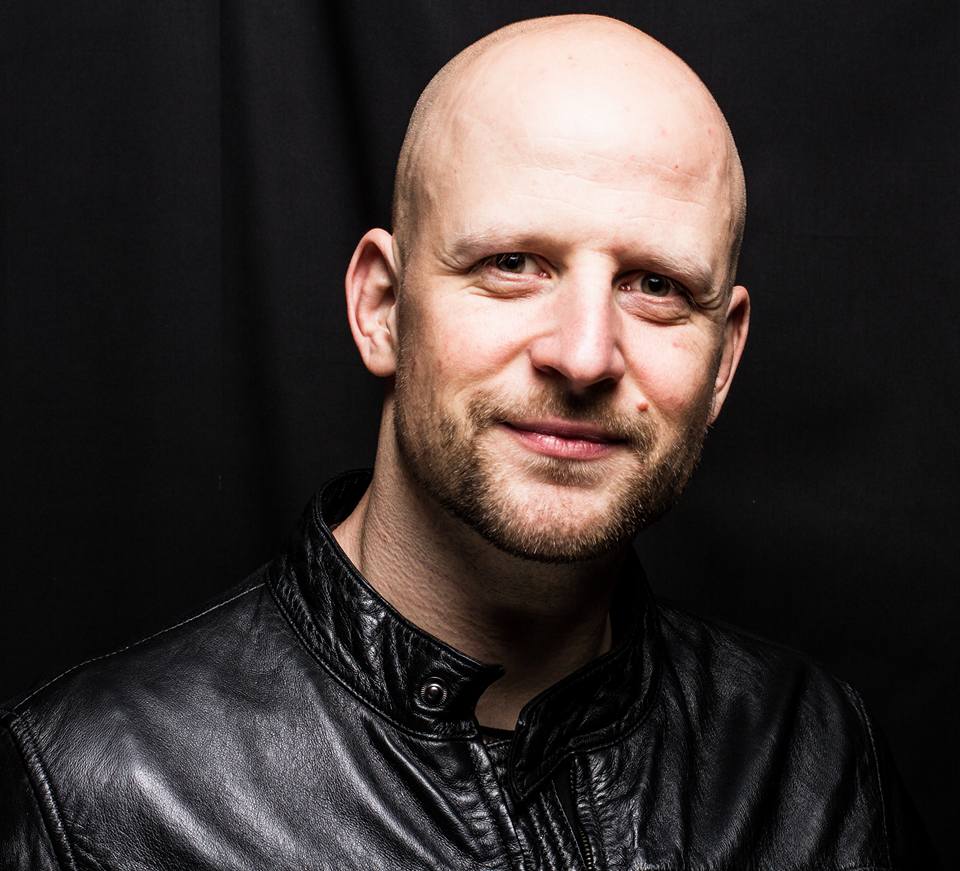



 We’re a group of Prog-lovers who started a journey to share with you our thoughts about albums, concerts, tours and festivals, the photo galleries of the Prog concerts we visit, as well interviews with upcoming or established musicians or prog-related people. Follow our Facebook page for frequent updates and news around the Progniverse.