


















BEAT @ Cirque Royal, Brussels – 23 June 2026
BEAT – Not a Museum Piece, but a Living Machine
King Crimson has never been one fixed memory for me. I saw the later incarnation with three drummers in Antwerp: an impressive, almost ceremonial machine in which the repertoire unfolded as a broad musical landscape. I also saw the David Cross Band several times, where the darker spirit of the 1970s emerged, with the violin cutting through the material like a sharp thread.
BEAT opened yet another room in that large house. This was not an overview of King Crimson’s full history, nor a nostalgic reconstruction of the classic years, but a sharp focus on the period of Discipline, Beat and Three of a Perfect Pair: the brief, distinctive phase in which King Crimson suddenly became more angular, nervous, funky and modern than ever before.
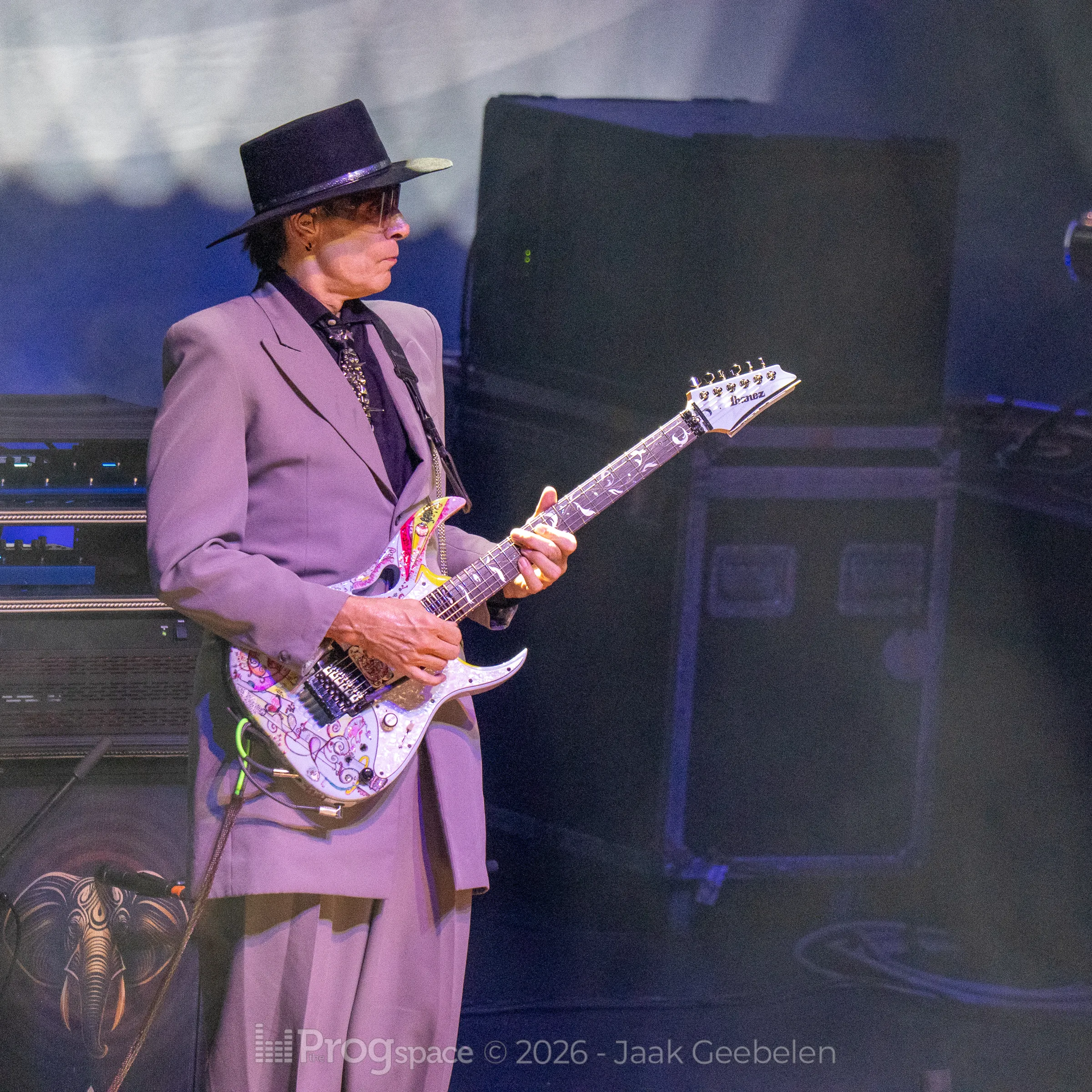
That BEAT is not an ordinary cover band is obvious. Adrian Belew and Tony Levin were there when this music was created. Steve Vai and Danny Carey take the places once occupied by Robert Fripp and Bill Bruford, without attempting to copy them literally. Yet that was also where the tension of this project lay. Vai largely moves within Fripp’s strict guitar architecture, only occasionally taking a more expressive route of his own. Carey is not the hard-hitting Tool drummer here, but a player who puts his immense technique at the service of rhythmic precision, colour and space.
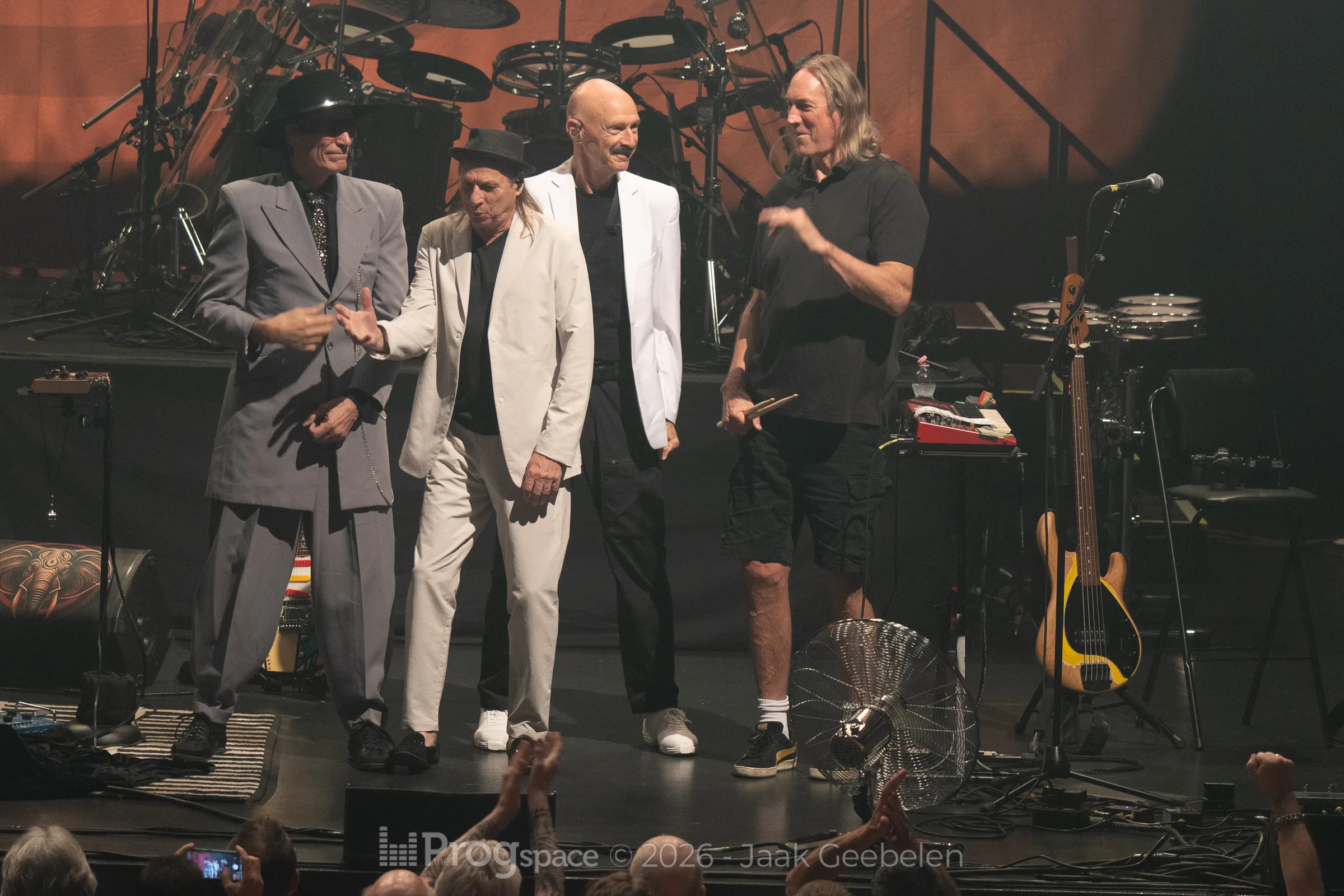
Cirque Royal held an estimated 1,500 people. The stalls were completely full, while there were still some open seats on the balconies. Even so, the room felt tightly packed and blood-hot. The audience responded enthusiastically throughout the evening, not only to the better-known songs, but also when the music became most demanding. By the second set, the stage itself looked more relaxed: the musicians’ clothing had become less formal, as if the heat had caught up with the carefully constructed appearance of the first half.
An elephant, a workshop and four distinct roles
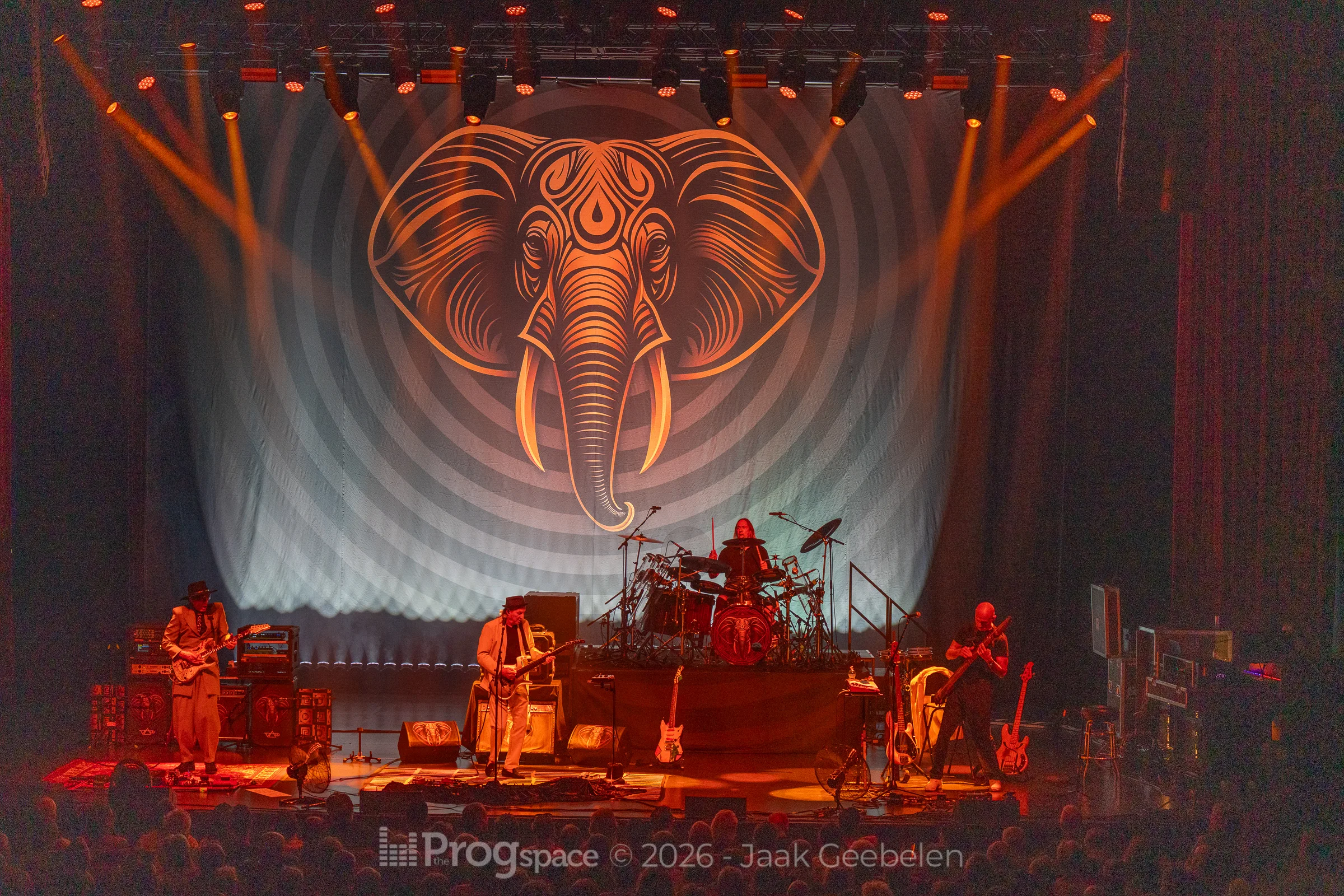
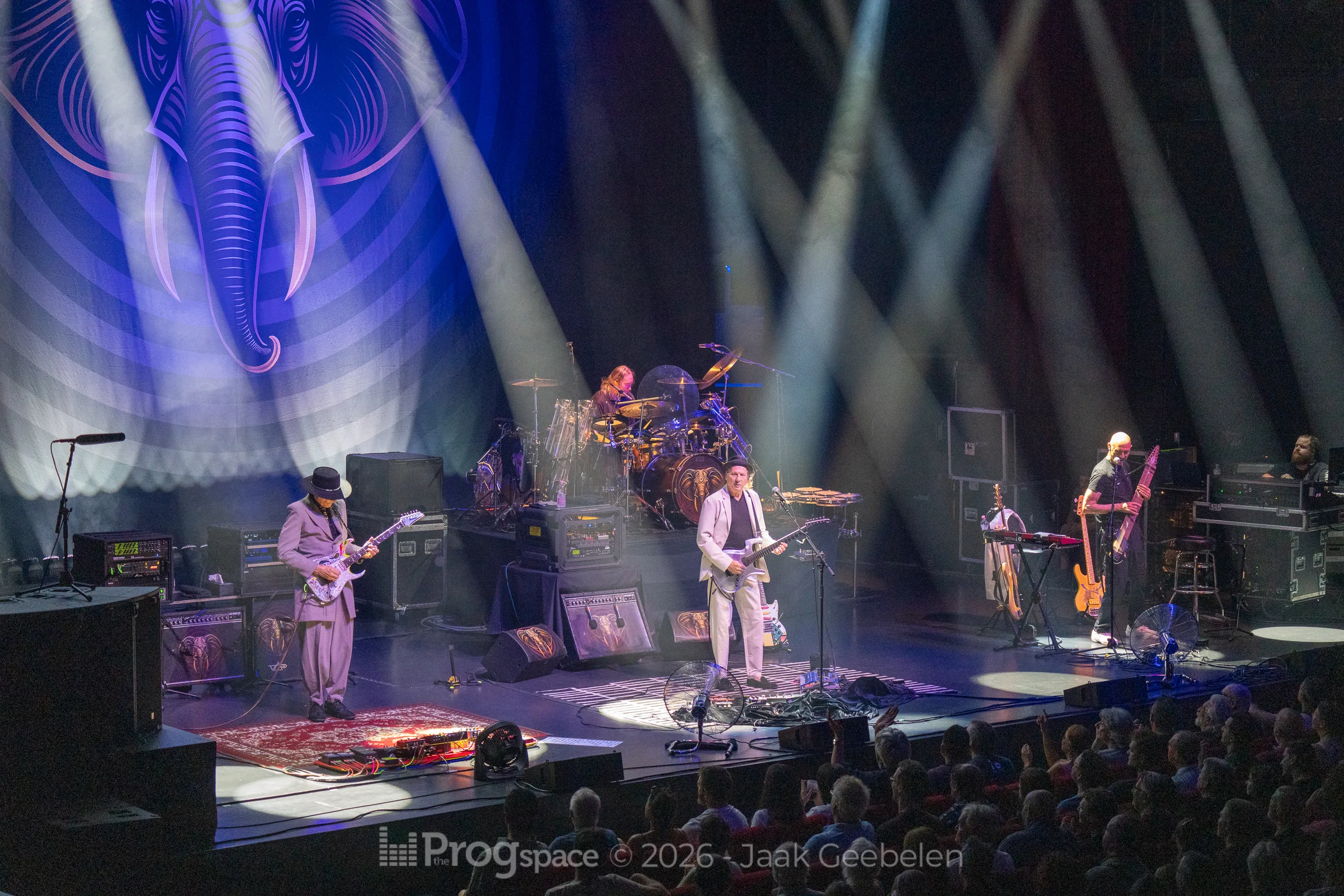
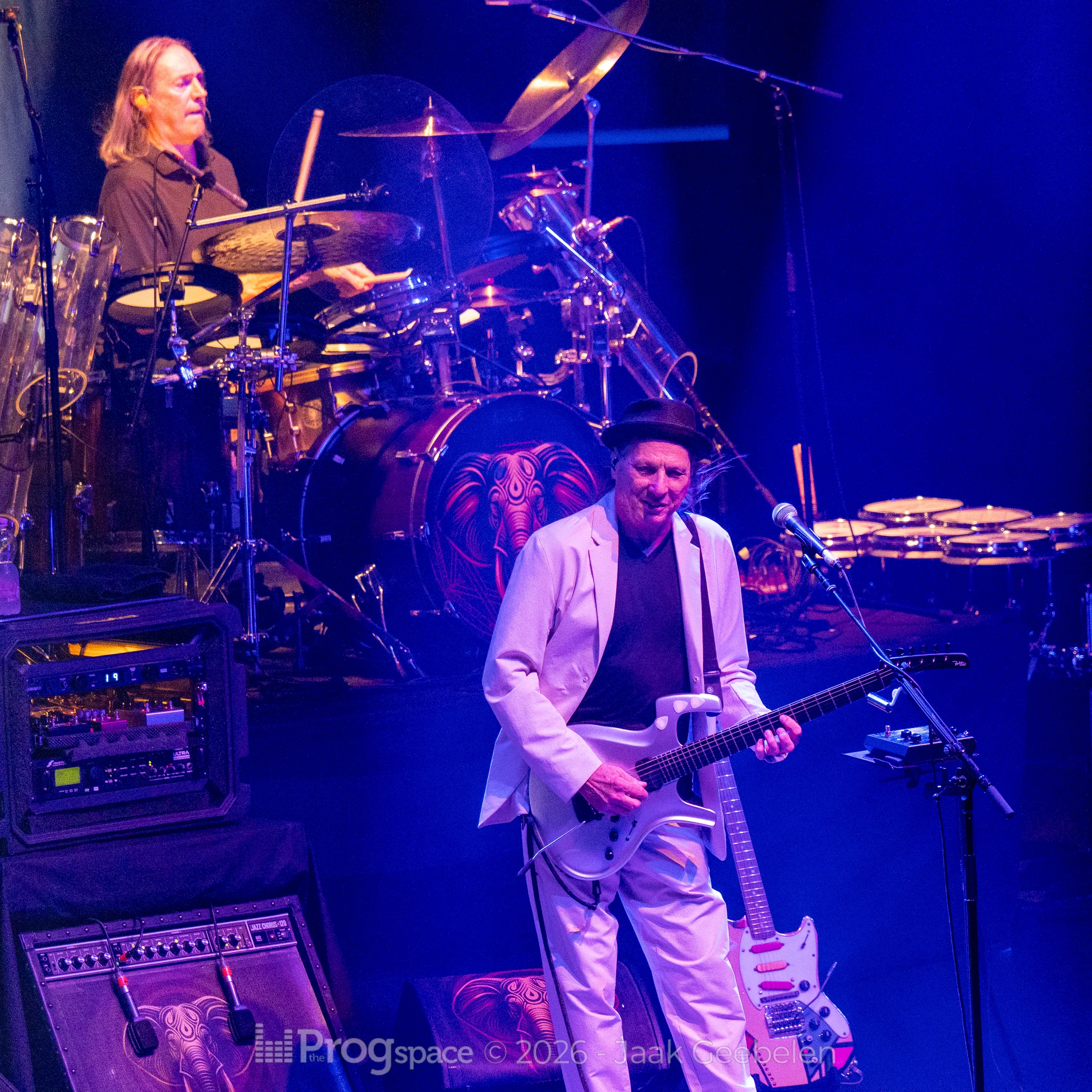
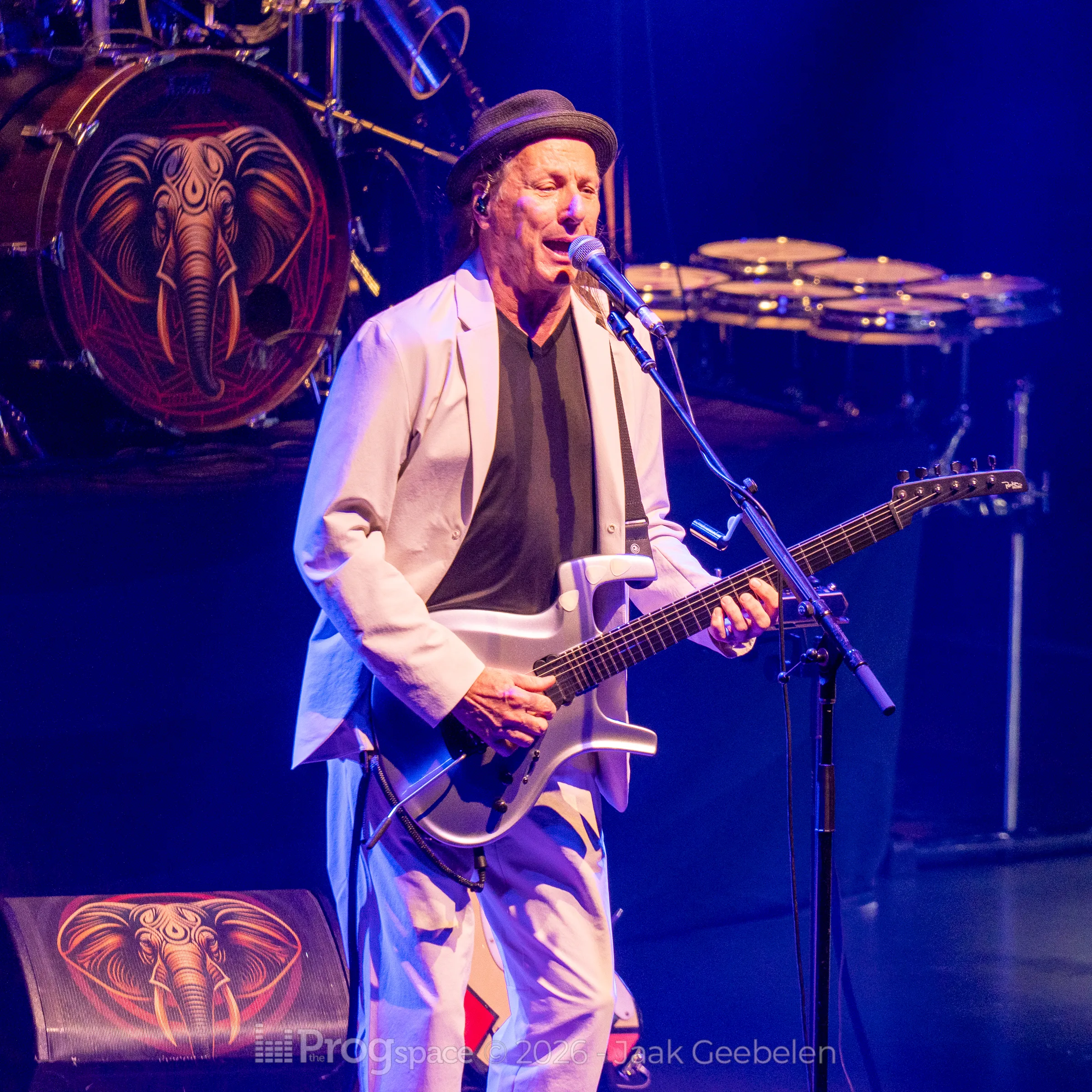
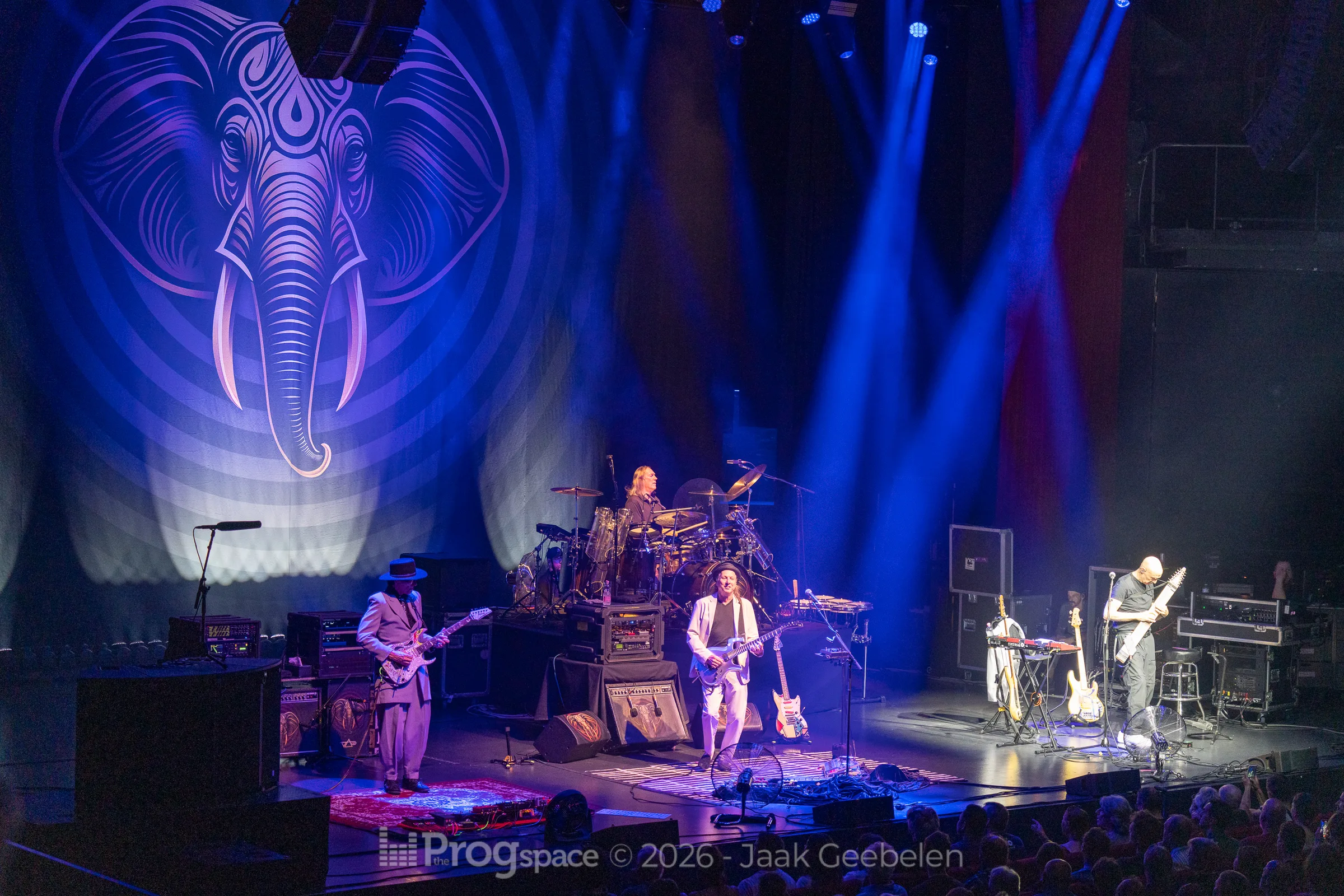
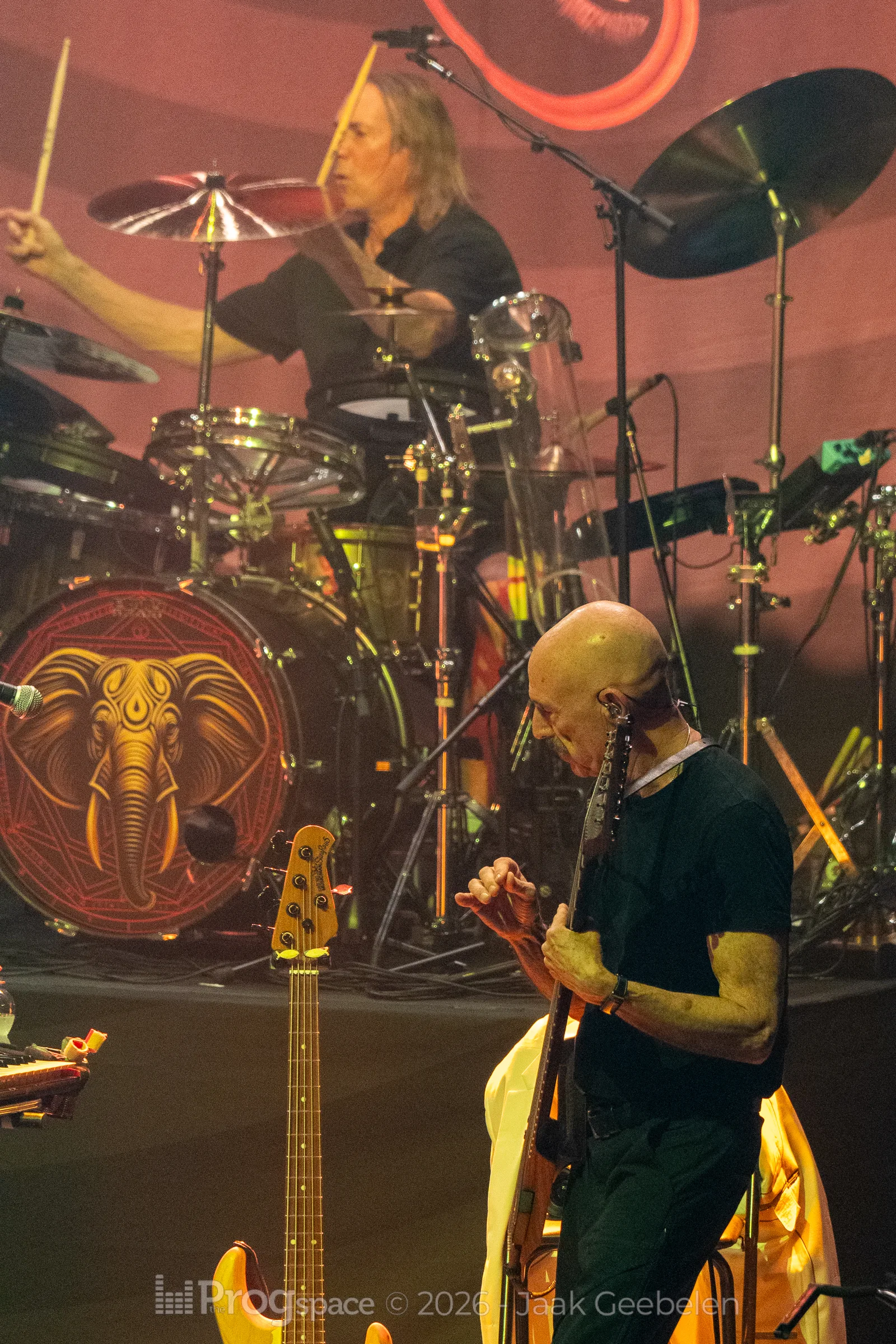
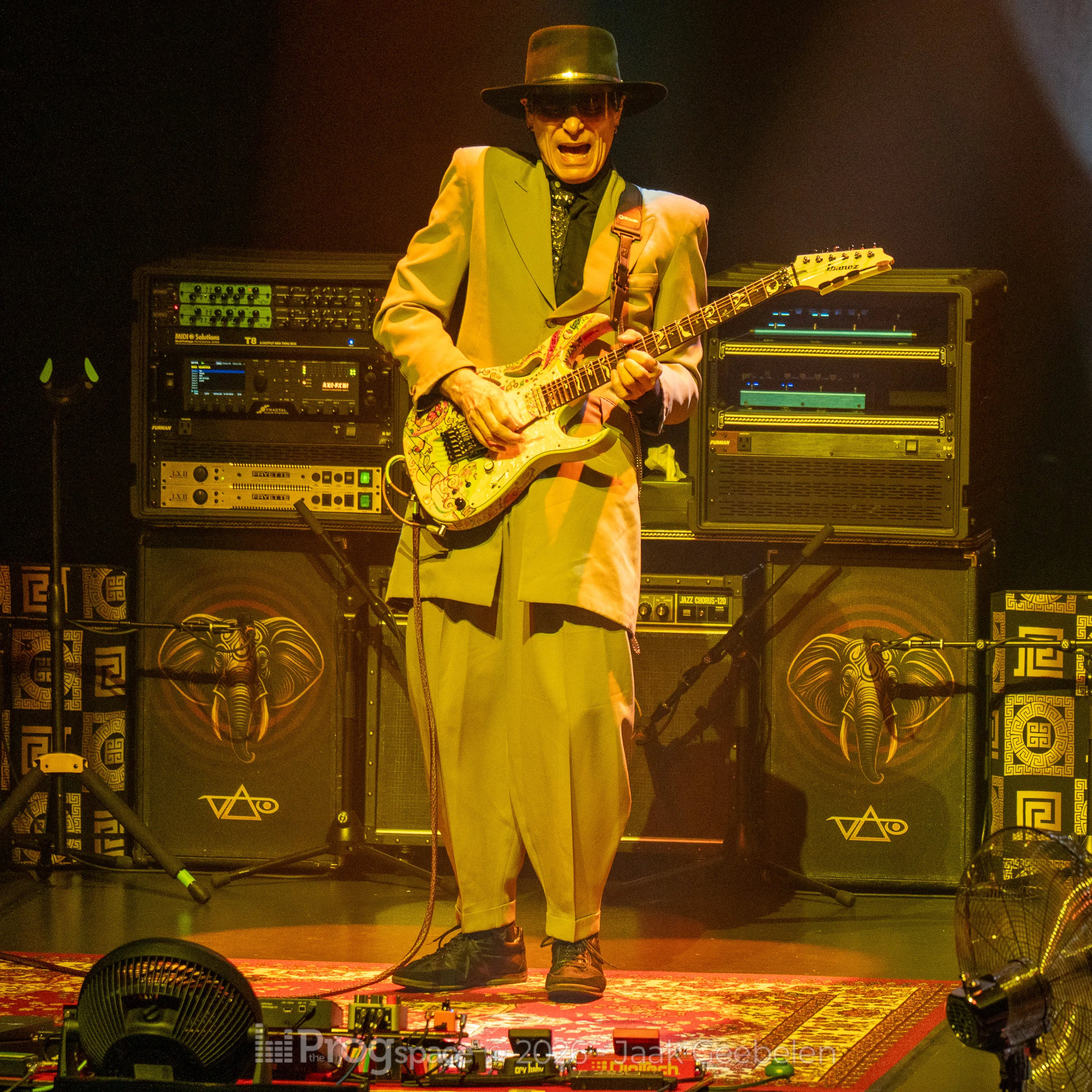
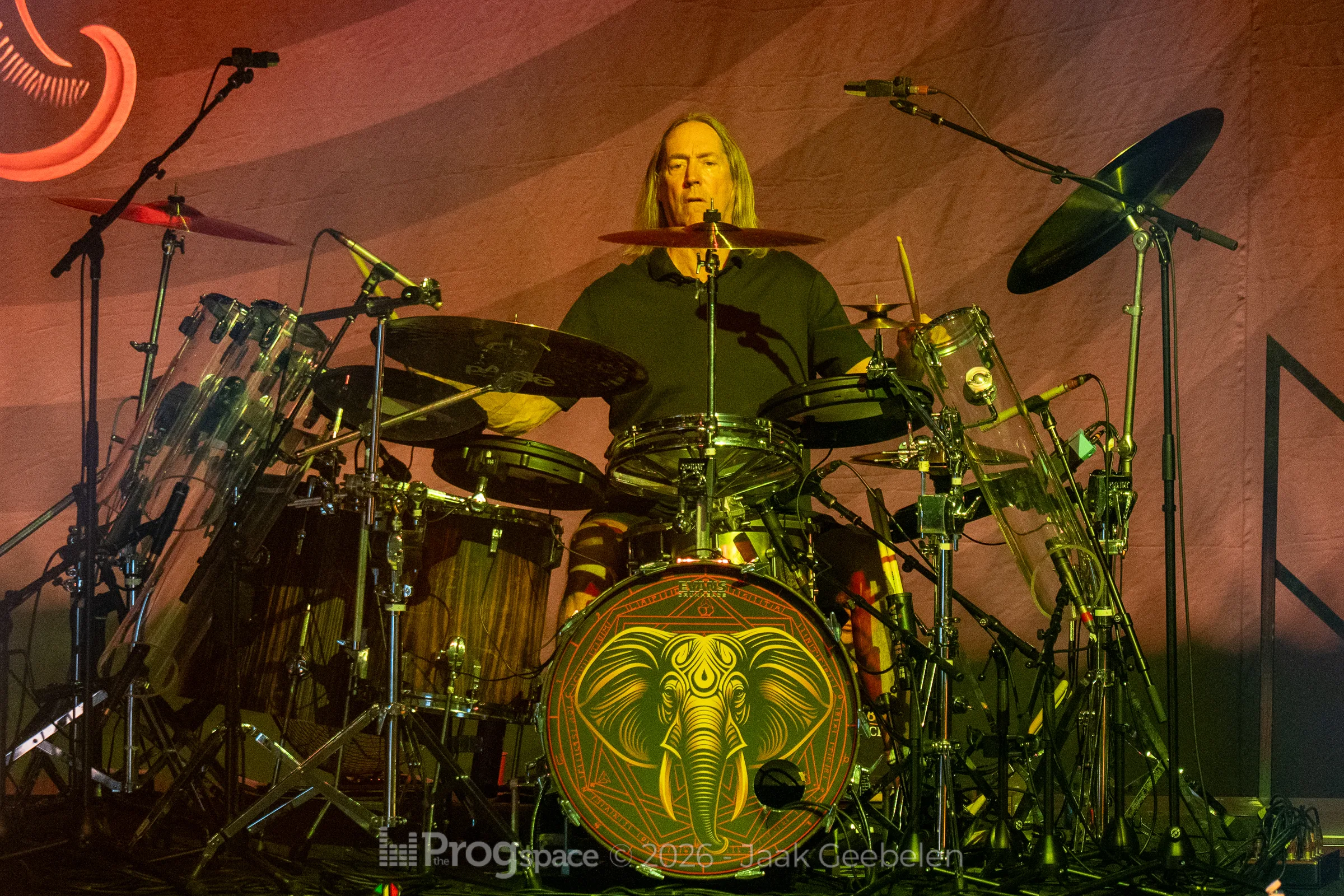
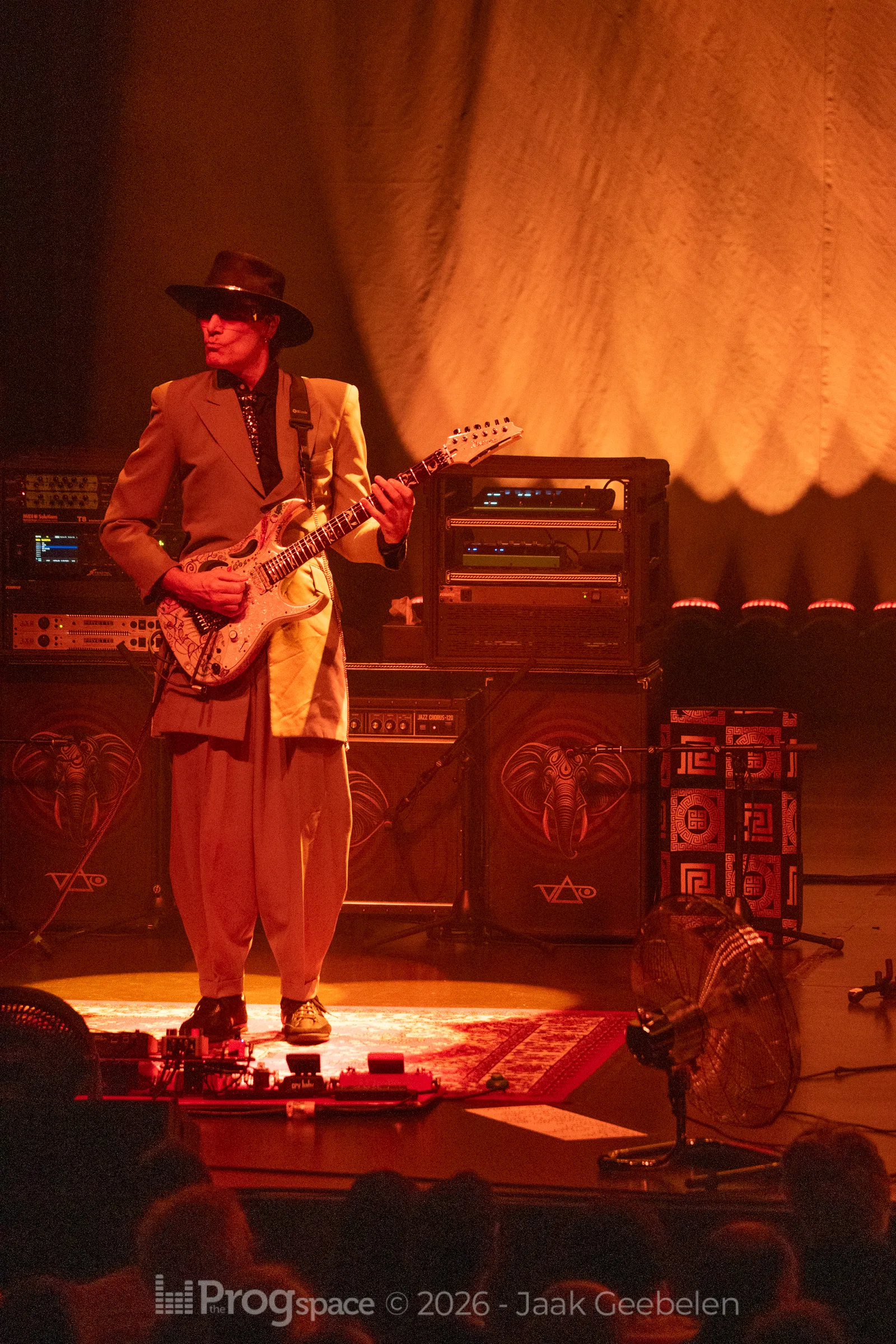
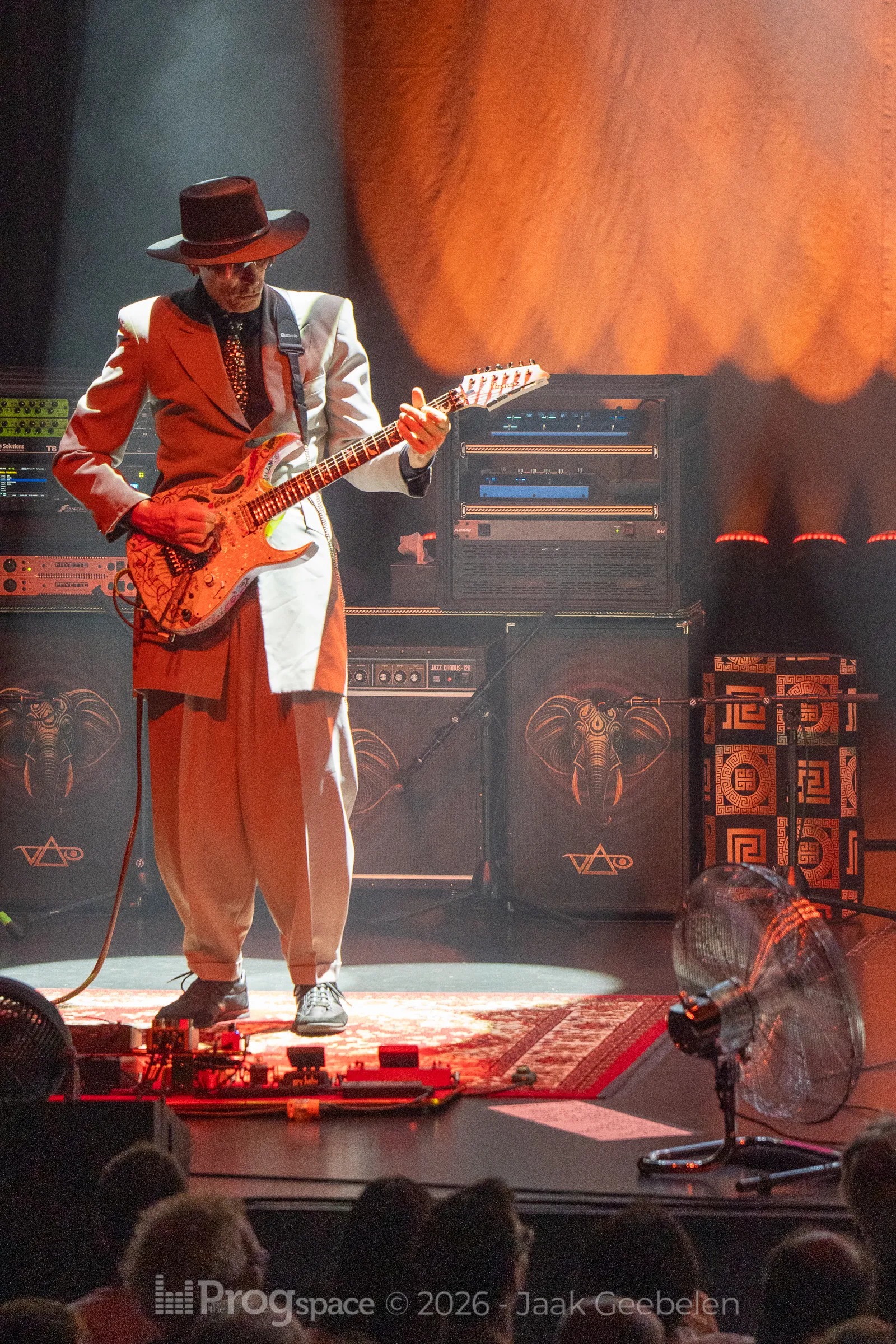
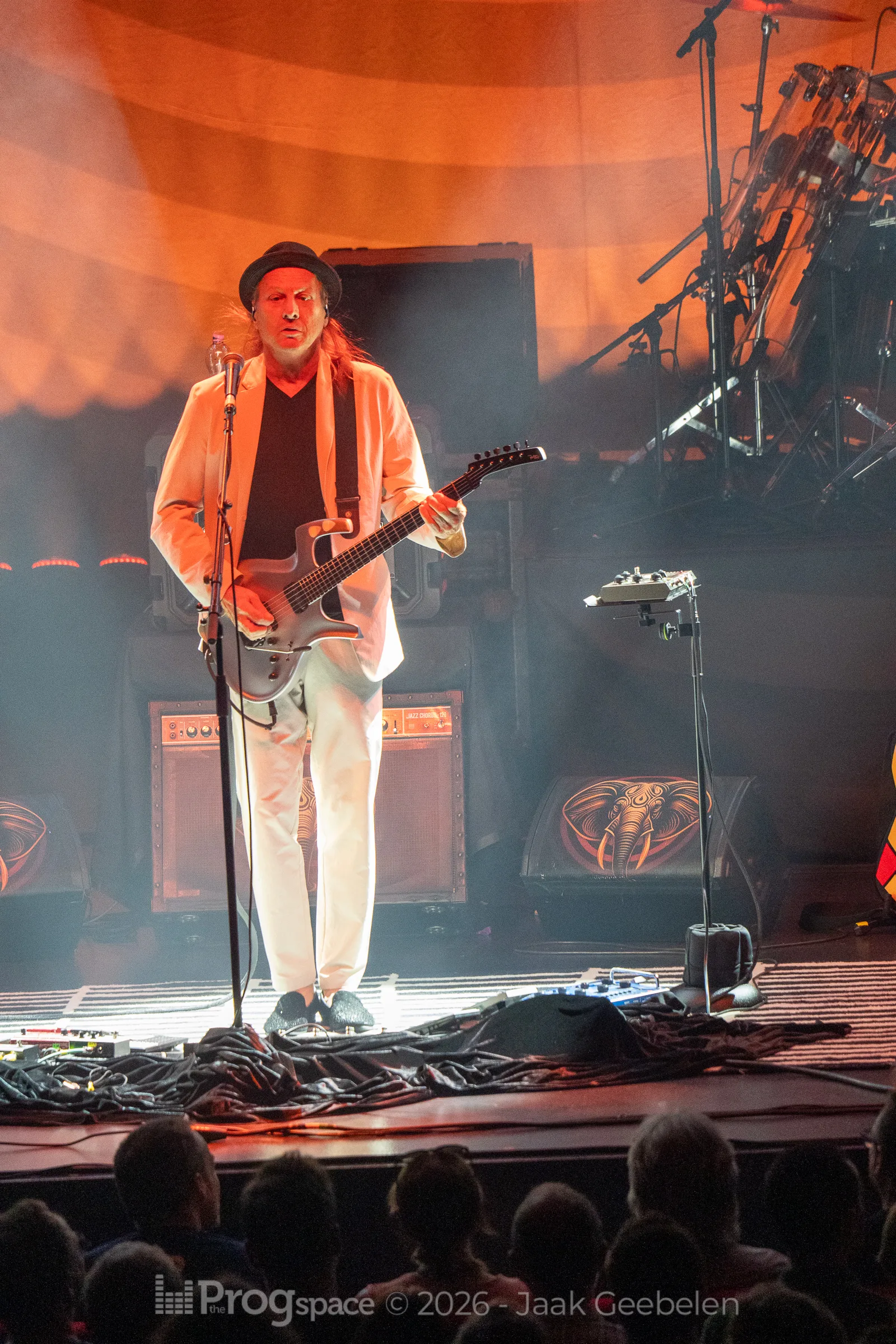
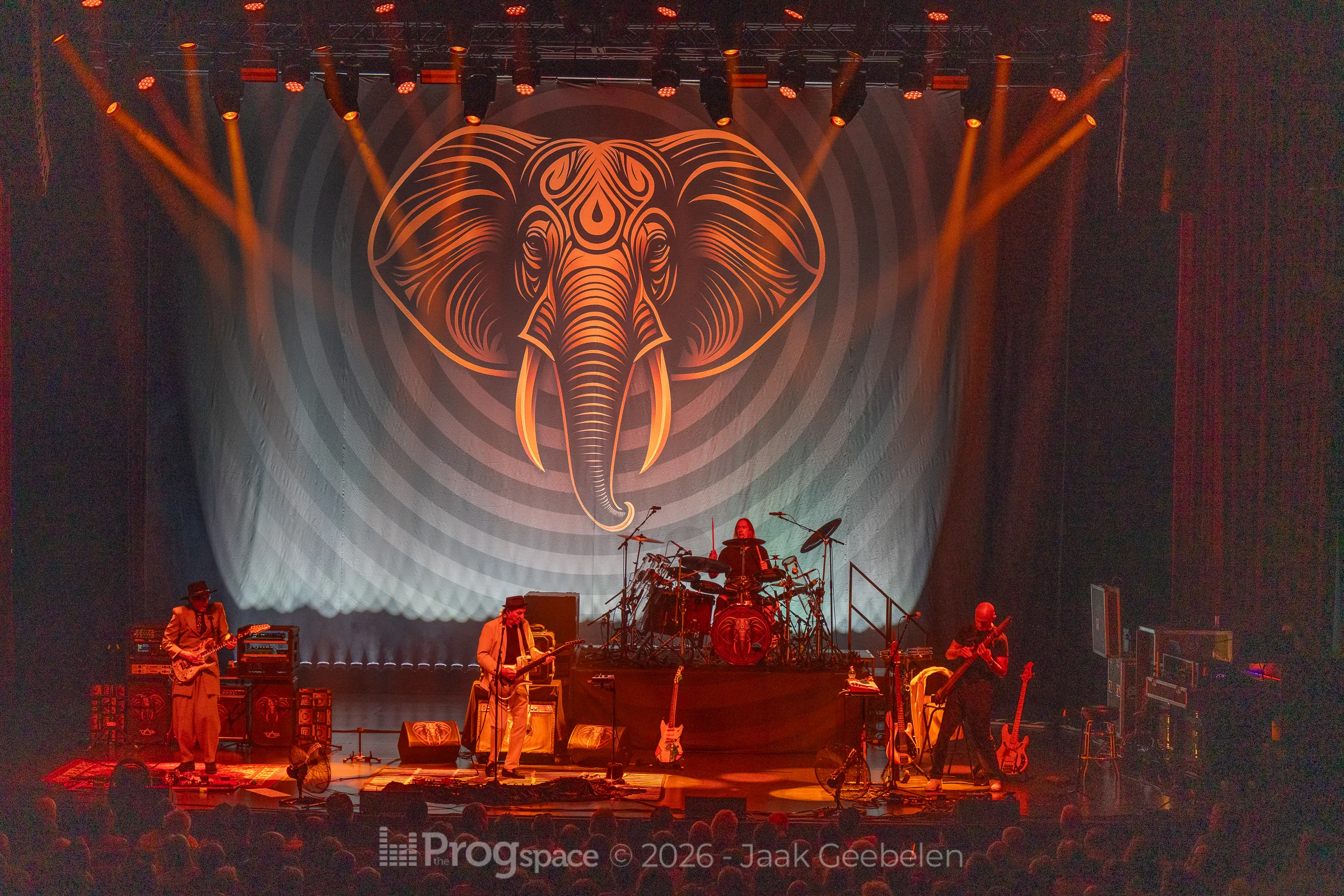
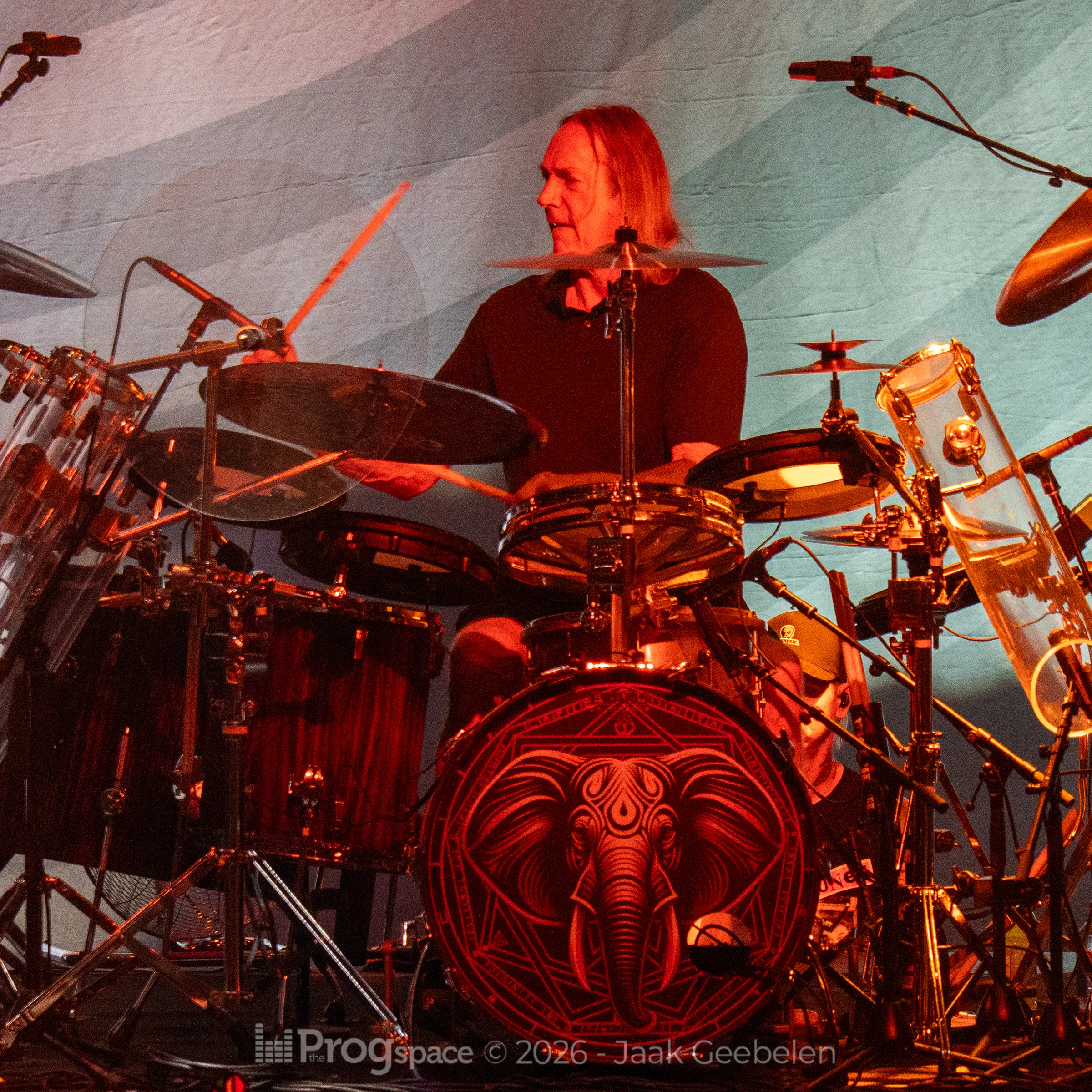
Visually, the production was coherent without being excessive. A huge stylised elephant dominated the backdrop. The motif returned on Carey’s bass drum, the monitors and the amplifier cabinets. During “Elephant Talk,” the elephant’s eyes even lit up: a small but highly effective detail, as if the set itself were listening to Belew’s stream of chatter, babble and commotion.
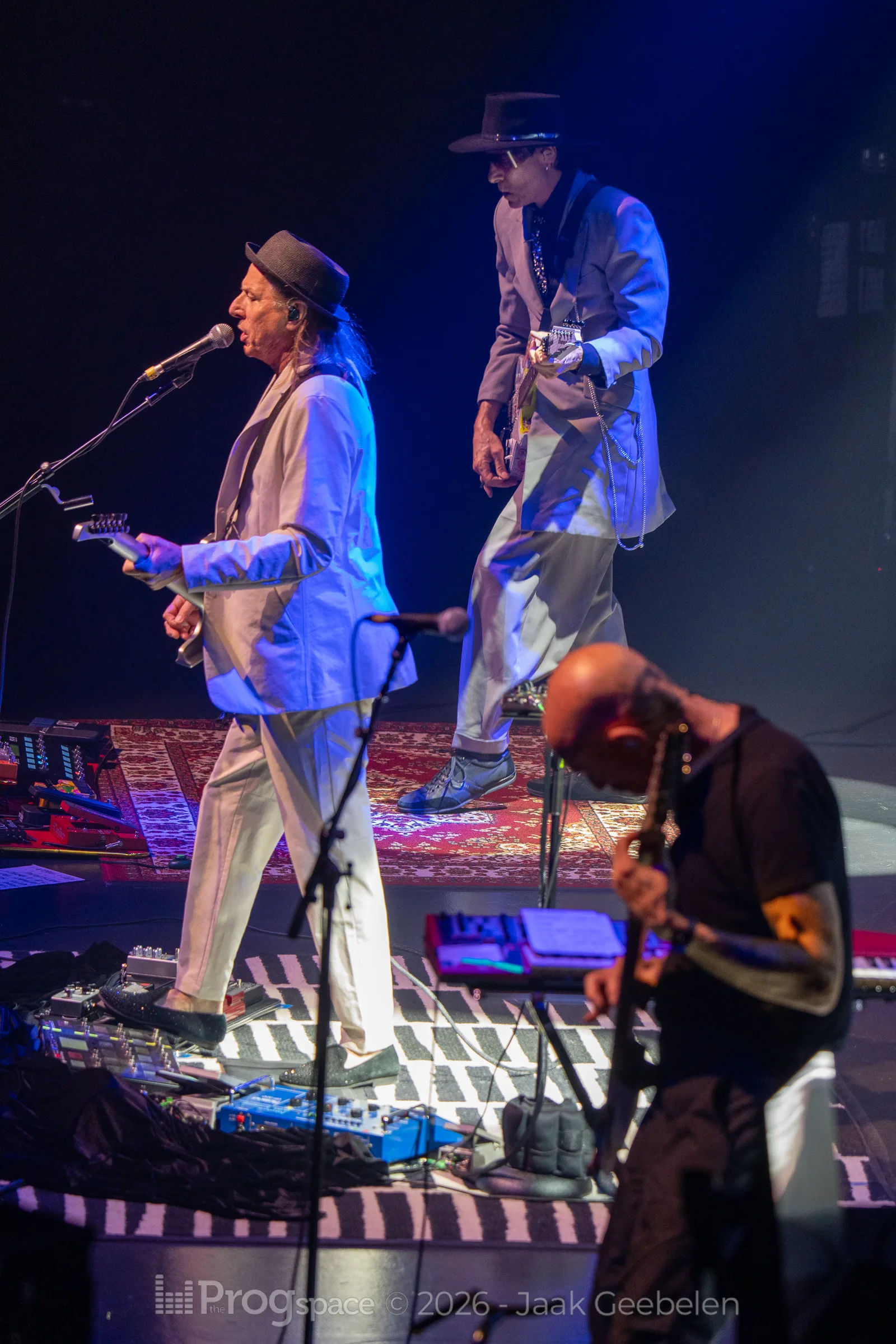
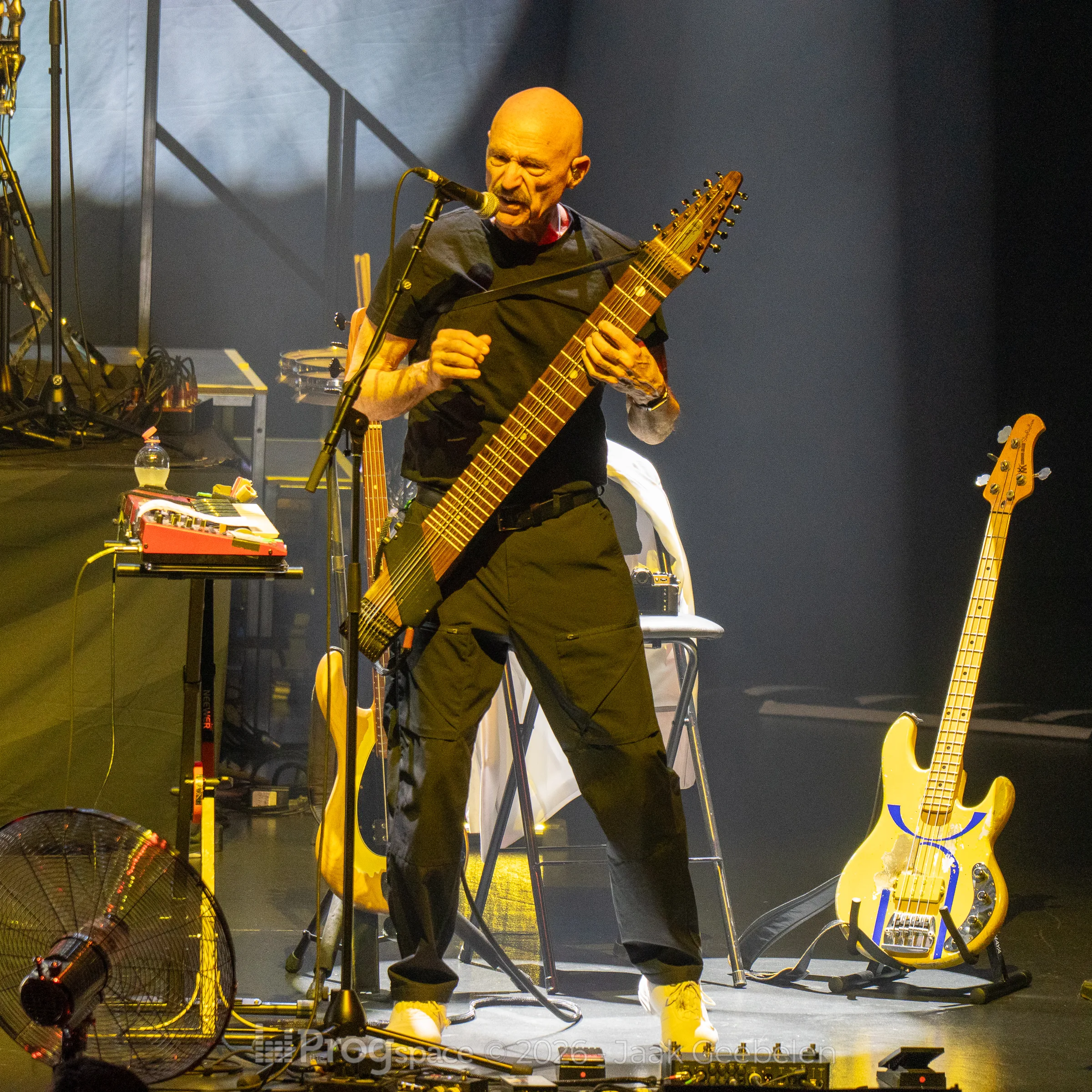
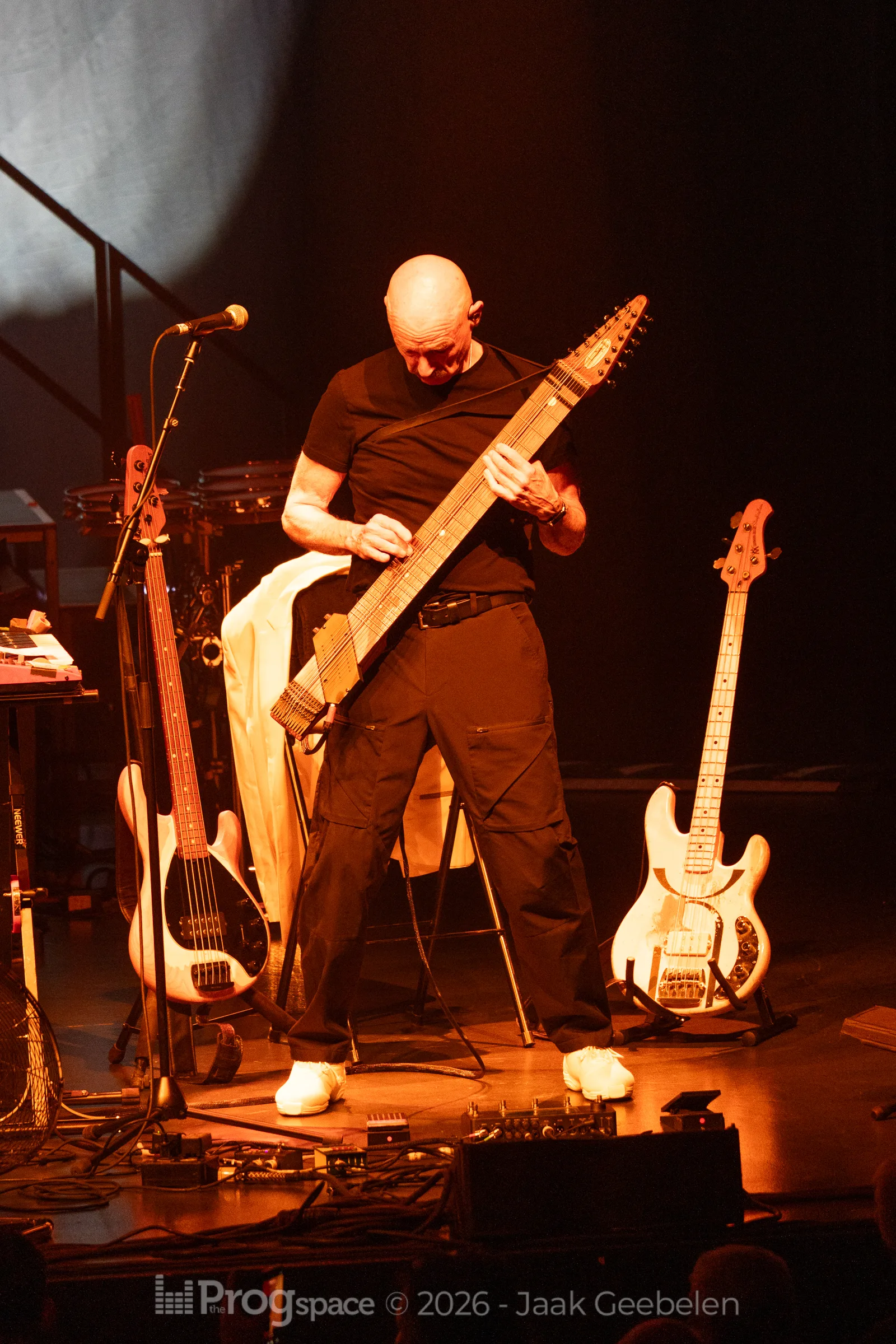
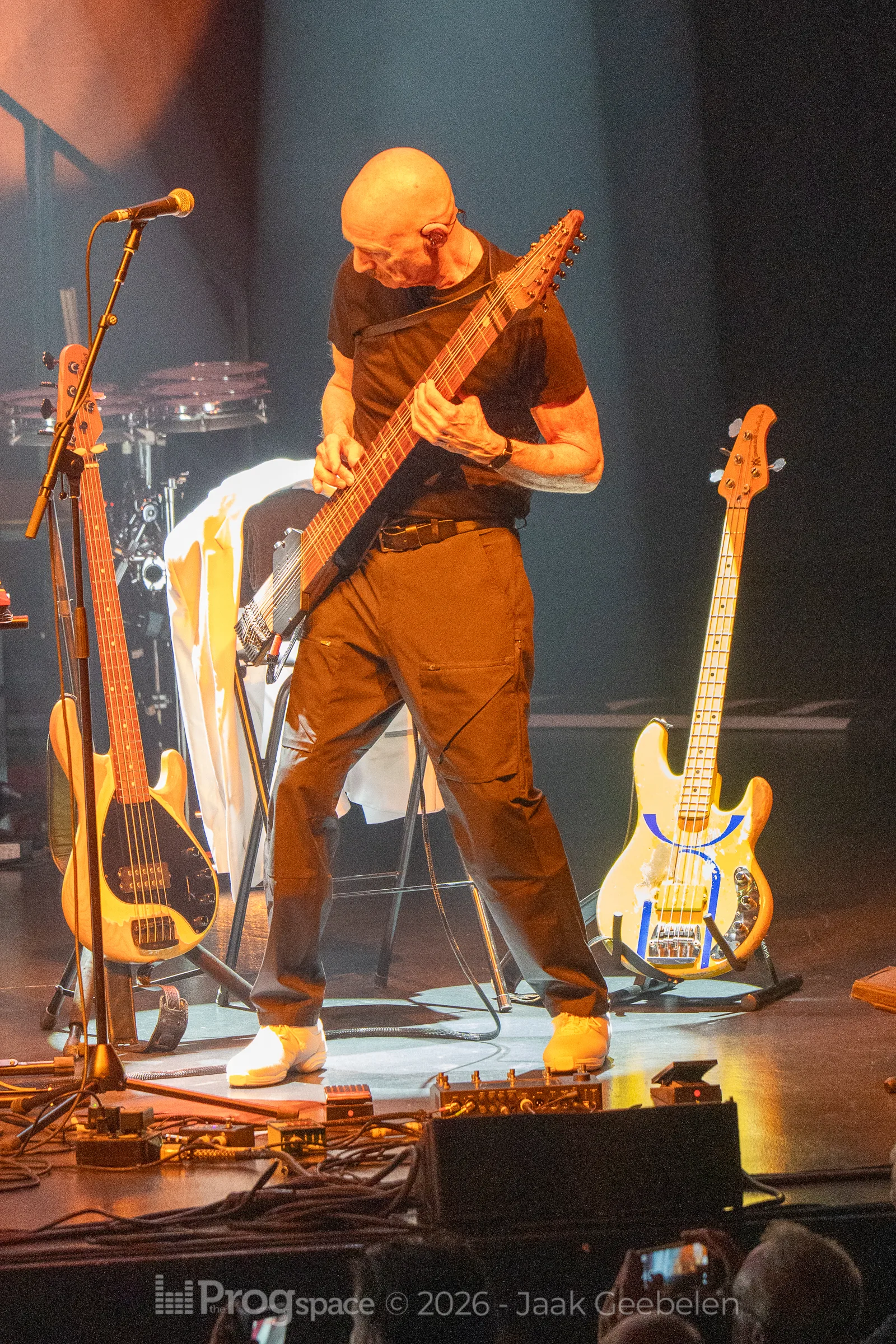
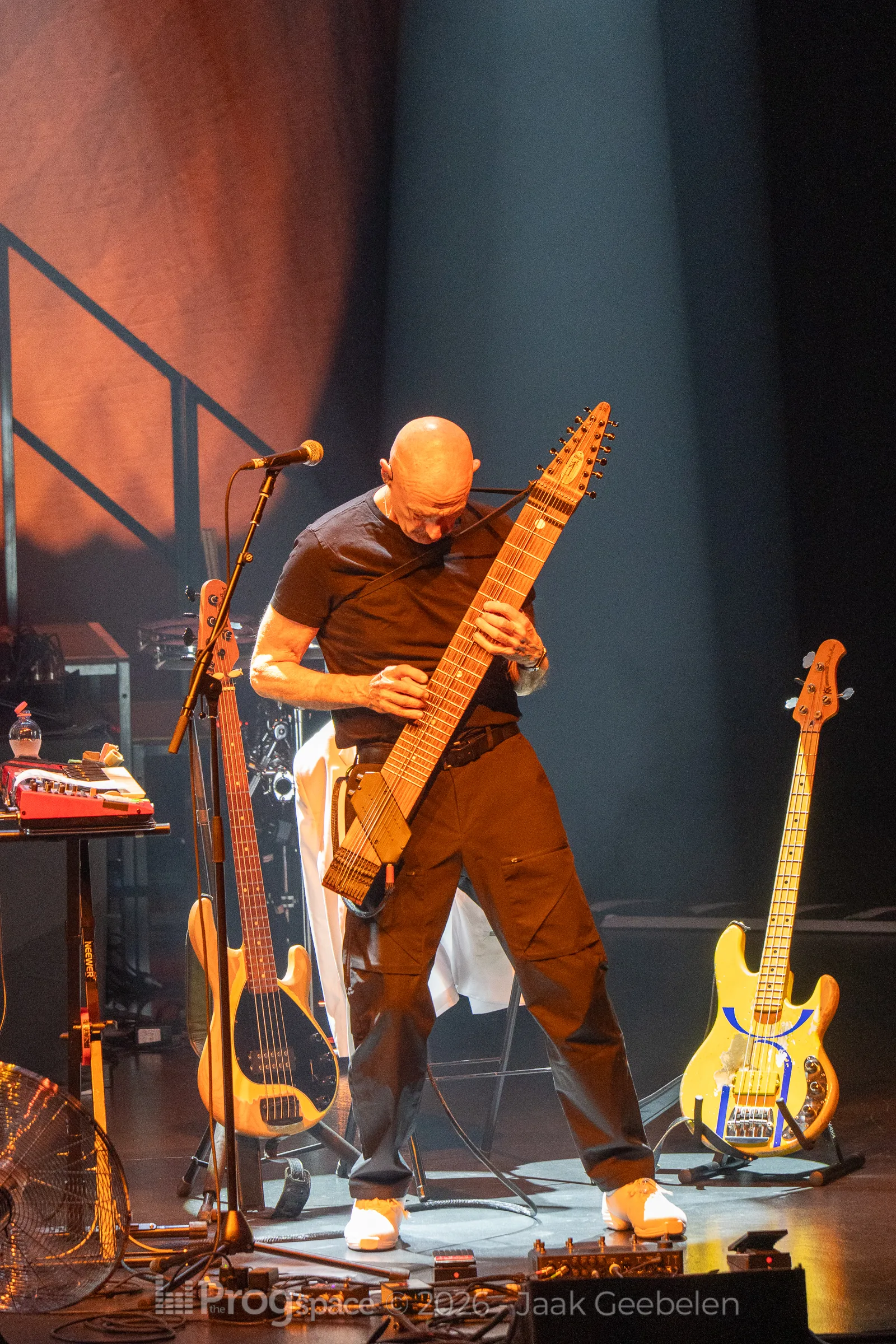
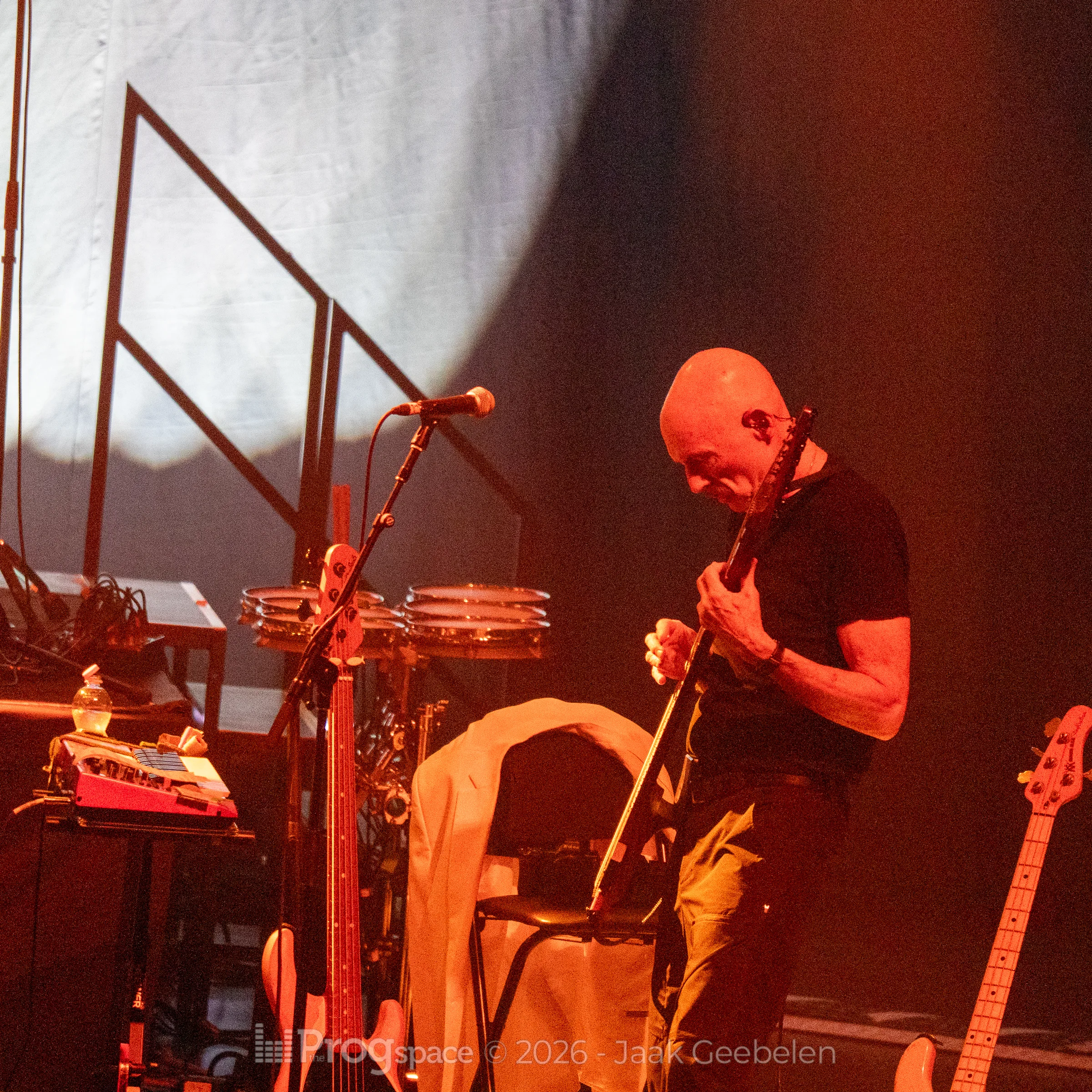
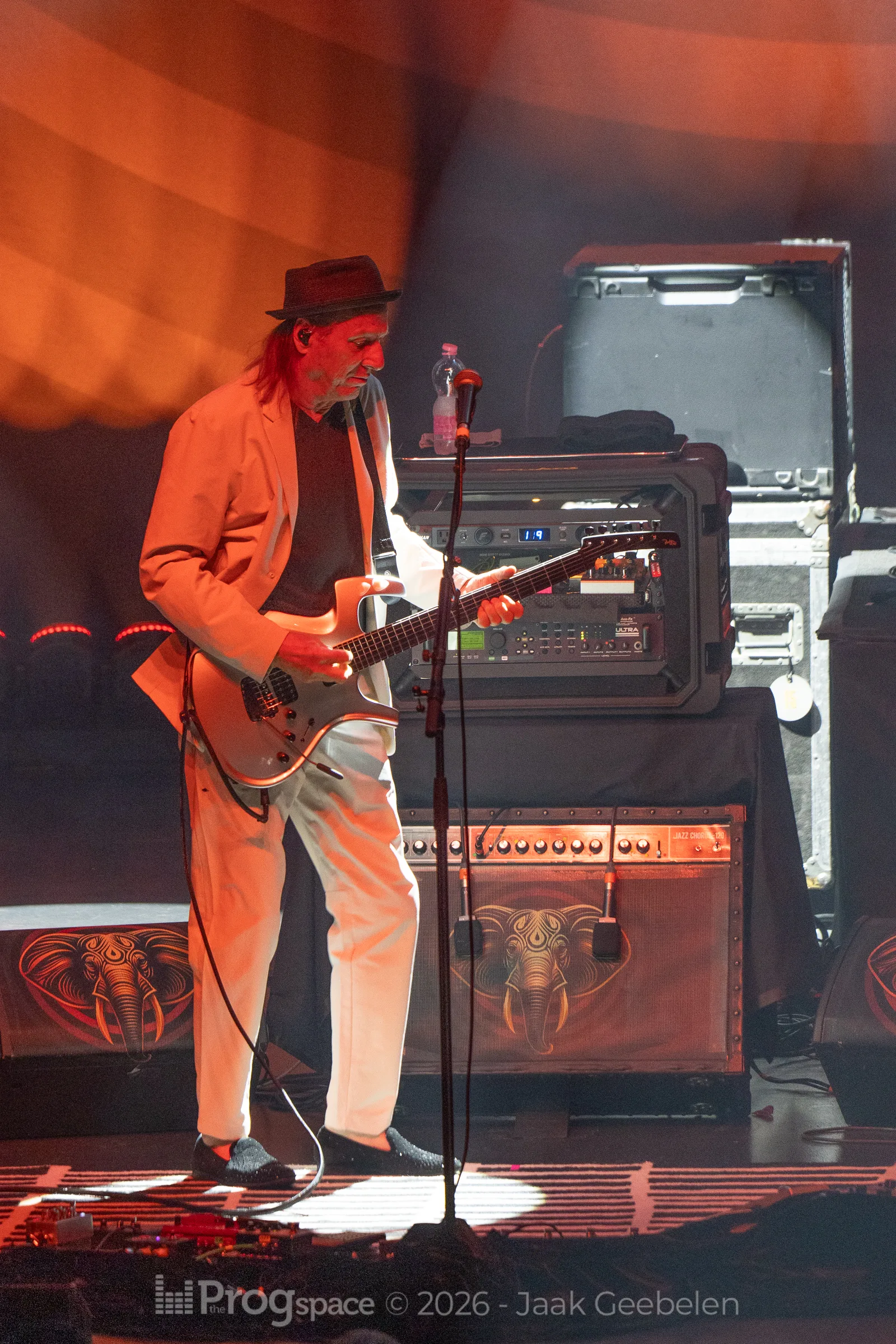
The stage layout revealed much about the roles within the group. Belew stood at the centre as frontman, with guitar, microphone and his unmistakable theatrical presence. Vai was surrounded by guitars, racks, pedals and effects equipment: visually, the sound architect. Carey towered over the group from behind his extensive drum set. Levin formed the calm pivot on the right, surrounded by basses and his Chapman Stick.
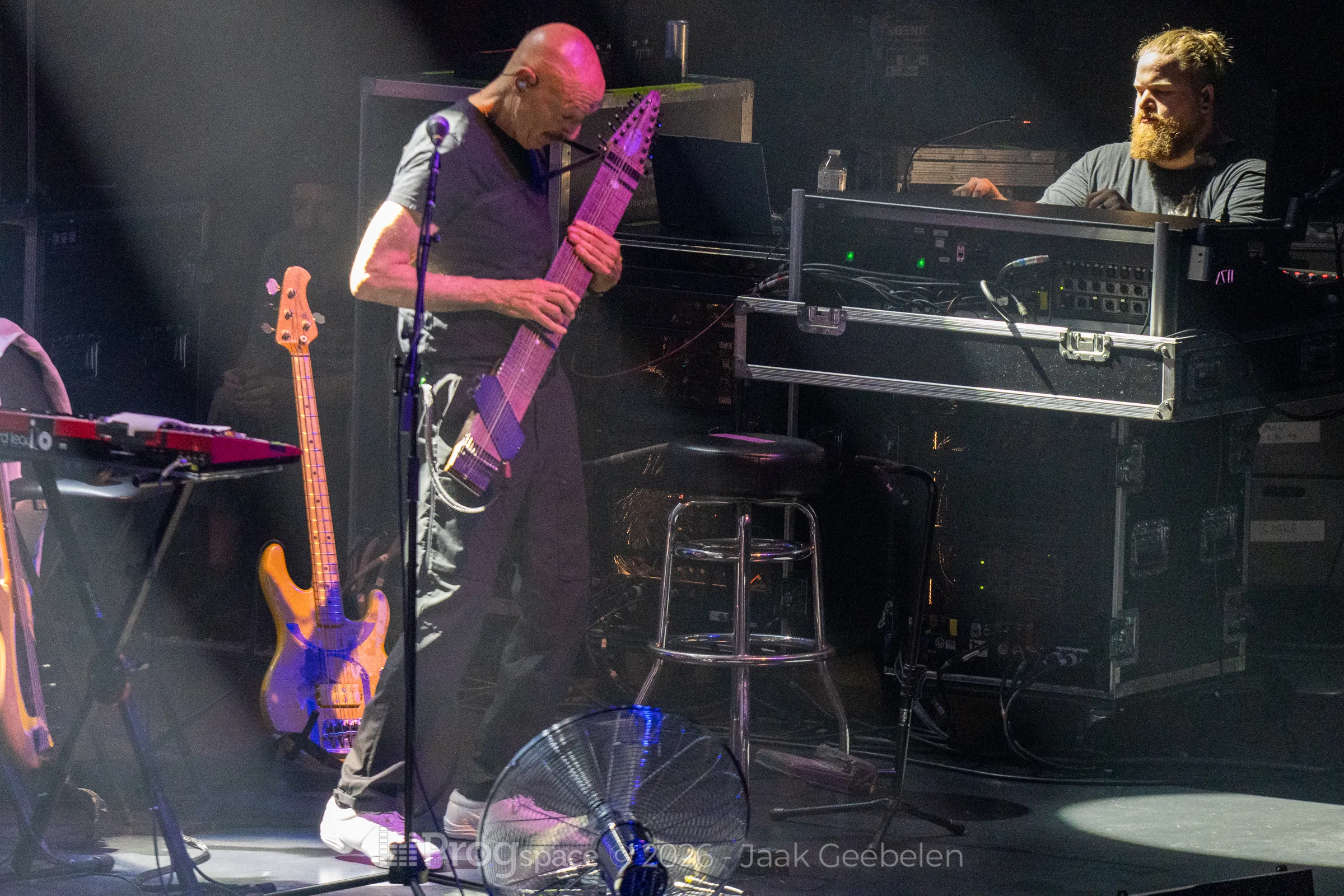
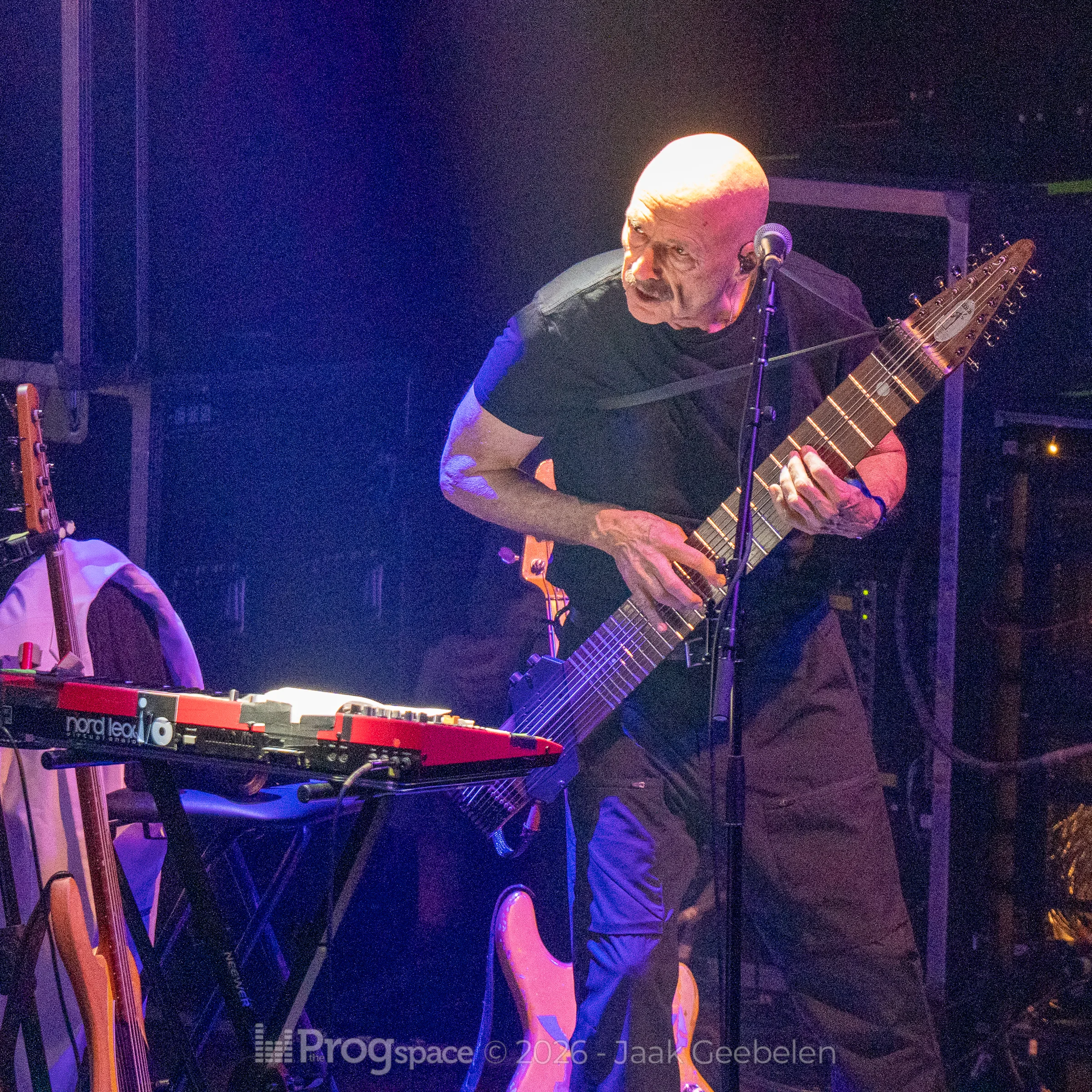
That Chapman Stick, in particular, made visible what Levin does in this music. He plays the instrument with both hands, somewhere between bass, guitar, keyboards and percussion. Where the guitars interlocked like cogwheels, Levin’s Chapman Stick was the axle on which the entire mechanism turned.
For Belew and Vai alike, there was almost as much music at their feet as in their hands. The long rows of pedals and switches were not decoration, but part of the sound world itself.
The old-school stage set-up was striking too, with visible amplifiers, speaker cabinets, racks and a substantial amount of equipment. At a time when many bands use digital rigs and almost empty stages, that physical backline underlined BEAT’s craft-based character. The complex music was not hidden behind an invisible system, but built visibly and audibly: Vai and Belew among pedals and amplifiers, Levin with bass and Chapman Stick, Carey behind his extensive drum and percussion set-up. The stage showed not only the result, but also the tools with which this demanding music was made.
First set: nervous cities, machines and skewed songs
“Neurotica” began with a whistle-like signal and a frantic, rapid launch. The band immediately entered the urban anxiety that defines so much of Beat. Carey drove the rhythm forward, while Belew laid his half-sung, half-spoken delivery over the top like an unsettled commentator. The music sounded compact, tense and, at the same time, surprisingly playful.
“Neal and Jack and Me” showed how thoroughly Vai had absorbed this musical language. The angular guitar patterns remained tightly locked together, but towards the end he was given space for a sharp, explosive solo. It was not an overtly virtuosic display, but a controlled break-out within a highly disciplined system.
With “Heartbeat,” there was temporarily more melody and openness. Levin filled out the prominent keyboard parts, while Belew gave the song its peculiar combination of pop sensitivity and estrangement. That mobility may be the strongest characteristic of this King Crimson period: the songs can seem accessible, but beneath the surface everything continues to shift at odd angles.
“Sartori in Tangier” was one of the first major instrumental moments. A rhythmic pulse remained present throughout as a motor. That constant propulsion briefly brought Angine de Poitrine to mind: not as an influence, but as a personal association with repetitive, angular music that works almost physically. Above that undertow, a piercing, singing guitar line developed, carrying an Eastern flavour. Levin held it all together with a funky, mobile bass role.
Then came the Three of a Perfect Pair section. “Model Man” brought out a more song-oriented, almost new-wave side of that album. “Man With an Open Heart” maintained that melodic line, without ever fully losing its strange underlying tension.
“Dig Me” brought back the disruption. It began as a dissonant confrontation between guitar and drums. Belew answered with distorted talk-singing. A short melodic fragment would occasionally break through, only to be swallowed again by cacophony, as if the instruments themselves had begun to argue with one another. The song remained deliberately uncomfortable and erratic.
“Industry” opened up an entirely different sonic space. Electronic, cinematic soundscapes drifted through the hall, while a sustained bass pulse kept working in the background. The piece did not begin from a riff or a chorus, but from layers: sounds emerging, shifting, scraping against each other and dissolving again. The result was something like an industrial film set in sound, with an underlying motor that never entirely disappeared.
“Larks’ Tongues in Aspic Part III” closed the first set as a bridge towards the older, heavier King Crimson tradition. The characteristic Larks riffs were immediately recognisable, with Levin on bass guitar as a firm foundation. BEAT then pushed the piece into a more angular, almost math-rock direction. Yelping, screaming and lightning-fast guitar sounds gave it a different nervousness from the original version, without losing its recognisable identity.
Second set: ritual, space and release
The second set opened with “Waiting Man,” one of the evening’s most visual moments. Danny Carey left his large drum kit and sat down at a smaller percussion set-up at the front of the stage. Adrian Belew stood opposite him, sticks in hand. For a moment, they were no longer singer and drummer, but two percussionists building a ritual foundation together.
That foundation was then built up layer by layer: first guitar, then vocals and bass. Carey showed and demonstrated just how broad his role in BEAT is. His drumming was not about brute force, but about precision, colour and gradual tension.
“Waiting Man” flowed into “The Sheltering Sky,” the undisputed centrepiece of the evening. The piece began with a tam-tam-like percussive pulse. Above it emerged Vai’s guitar: sliding, singing, almost violin-like. The rhythm section maintained a brooding undercurrent, while the two guitars set themselves against one another like angular cogwheels.
Levin played a melodic riff that repeatedly broke through the haze of sound. Eventually Vai took command with a memorable solo. Not fast for the sake of speed, nor virtuosic for the sake of virtuosity, but spacious, expressive and charged. During “The Sheltering Sky,” Vai seemed to step outside Fripp’s strict geometry for a moment — not to take the song for himself, but to make visible the buried emotion that Fripp often kept behind control.
“Sleepless” then pulled everything back towards the physical. Levin began with a bass introduction that briefly recalled Chris Squire, with a vague personal association with “Night of the Sunrise.” Then came Belew’s murmured vocals, a complaining guitar line, funky bass and Carey’s fast drum pattern, all joining in a short, energetic burst. After the spaciousness of “The Sheltering Sky,” it worked as an explosive release.
With “Frame by Frame,” the Discipline principle appeared in its purest form. The extended introduction had been shortened, but it was replaced by a far more explosive guitar ending. After that brief opening, a pattern locked itself in and continued through the entire song. Belew placed his half-sung, half-spoken delivery over it, while the guitars interlocked at extreme speed and precision. It was complex music that never became clinical: beneath the exactness, there remained a nervous, almost chaotic tension.
“Matte Kudasai” then brought fragility and space. The guitar had such a sliding, crying sound that it briefly suggested a lap steel — without there actually being one on stage. It was a beautiful break from the angular precision of the rest of the set: a fragile, floating song in which Belew’s voice did not need to force anything.
“Elephant Talk” became both the visual and musical emblem of the show. The elephant on the backdrop gained glowing eyes. The music was funky, exceptionally tight and almost danceable, albeit on King Crimson terms: skewed, nervous and slightly absurd. The guitars seemed to converse with one another; at certain moments, one even sounded like a trumpeting elephant.
Belew’s talk-singing had something distinctly Zappa-like: rhythmic, absurd, precise and playful. In his playing, echoes of his past with Talking Heads and Frank Zappa could still be heard: rhythmic nervousness, sonic imagination and a strange sense of humour. The lyrics of “Elephant Talk” are not a linear story, but a catalogue of human communication as noise: babble, chatter, quarrelling, arguments and fuss.
“Three of a Perfect Pair” then found Belew singing more melodically, with a recurring refrain above a swaying rhythm. It had something reggae-like about it, but nothing warm or relaxed: closer to the dry, nervous new-wave reggae of The Police than to roots reggae. The groove was there, but it was continuously processed through the King Crimson machine.
“Indiscipline” grew into an uncompromising end to the regular set. First came short bass pulses. Carey then broke out into a complex drum solo in which he emphatically stole the show. Next came a wailing, almost violin-like guitar. Only then did the bass pulses return, together with Belew’s spoken vocals.
In some of his raw vocal outbursts there was even something of Joe Cocker: physical, unpolished and abrasive. For a brief moment, there was also a personal association with the introduction to U.K.’s “In the Dead of Night” — not as a direct stylistic similarity, but through the combination of technical pressure, dramatic rhythm and virtuosic tension. Then it became unmistakably Crimson again: dry, manic, absurd and controlledly unhinged.
A heavy encore and an urban finale
“Red” was the one clear step outside the three 1980s albums. The song worked as a historical shockwave: more massive, direct and heavier than much of what had come before. It sounded like a reminder of a different, more brutal King Crimson period.
With “Thela Hun Ginjeet,” BEAT ended in motion. The combination of nervous grooves, guitar lines and Belew’s spoken passages made for a fitting finale: not a solemn conclusion, but one final eruption of metropolitan fever.
Not an easy victory
BEAT did not prove that King Crimson can simply continue without Robert Fripp. That would be too easy. What this group did prove is that this specific music can breathe again outside Fripp’s presence.
The tension between reconstruction and deviation remained palpable throughout the evening. Vai and Carey approached Fripp and Bruford with respect, but they did not attempt to disappear into their shadows. Belew and Levin brought the memory of this music with them; Vai and Carey added different muscles, different colours and a different physical energy.
This was not an easy, audience-friendly journey through familiar prog classics. “Dig Me,” “Industry,” “The Sheltering Sky” and “Indiscipline” remained demanding. They required attention and a willingness not to understand everything immediately. But that was precisely the strength of the evening.
Once you enter the internal logic of this music, it becomes irresistible: angular, funky, cerebral, physical, absurd and surprisingly human. BEAT did not turn 1980s King Crimson into a museum piece, but into a living machine that still sparks, scrapes and bites.
Setlist
Set 1: “Neurotica”, “Neal and Jack and Me”, “Heartbeat”, “Sartori in Tangier”, “Model Man”, “Dig Me”, “Man With an Open Heart”, “Industry”, “Larks’ Tongues in Aspic Part III”
Set 2: “Waiting Man”, “The Sheltering Sky”, “Sleepless”, “Frame by Frame”, “Matte Kudasai”, “Elephant Talk”, “Three of a Perfect Pair”, “Indiscipline”
Encore: “Red”, “Thela Hun Ginjeet”
Special thanks to Ela Williamson for her invaluable musical insights, thoughtful discussions, and assistance in the preparation of this review.


 We’re a group of Prog-lovers who started a journey to share with you our thoughts about albums, concerts, tours and festivals, the photo galleries of the Prog concerts we visit, as well interviews with upcoming or established musicians or prog-related people. Follow our Facebook page for frequent updates and news around the Progniverse.
Very good review. Glad I was there.